When I met Dewayne Dedmon, he was a third-string center for the Orlando Magic. Seven feet tall, a genuine athlete, a real defensive presence — but he'd bounced between the NBA and the G-League for years without ever locking down a rotation spot, playing barely 12 to 14 minutes a night when he played at all.
The problem was the other end of the floor. The game was tilting hard toward the three-point line, and Dewayne couldn't be trusted to shoot. He struggled at the free throw line — 53% the season we started — and was quietly discouraged from shooting much of anything else. For a big man in the modern NBA, that's a hard way to stay employed.
The diagnosis
At the end of my first season with the Magic — the same year I'd been working with Aaron Gordon — I finally understood Dewayne's shot well enough to help. I could see the ball coming out flat, over and over.
The cause, as I read it, was his set point. He brought the ball back over — sometimes even behind — his head. From there he had no choice but to lift it up out of that position and then push it forward toward the rim just before release. Up, then forward. That little second move at the end was flattening the shot.
What he needed was a set point that let him go up and forward at the same time — out of the set point and toward the rim in one motion, instead of two.
“A set point behind the head forces a shooter to go up, then forward — and ‘up, then forward’ is what flattens a shot.”
Tweet thisVideo Shot Analysis
Some of the best work I've done happened through a screen — a player sends me their footage, and I send back a frame-by-frame plan for their shot. Get yours.
A complication
I'd helped players out of this exact pattern before, and I thought I could do it quickly. But there was a problem. The season was ending. Dewayne would be spending his off-season in Dallas; I'd be spending most of mine with another Magic player. For most of the months ahead, we simply weren't going to be in the same place.
Four days
So in the last four days of the season, we got to work — not on a finished jump shot, but on a handful of highly constrained drills. The point of the constraints was simple: give Dewayne a way to coach himself. The drills made his old habit — taking the ball back over his head — hard to do, and made exploring a new set point out in front of his forehead the path of least resistance.
I gave him a clear map: here's where you have freedom to explore, and here's where you have to stay disciplined; here's what a good rep feels like, and here's the mistake to avoid. Then the season ended, and he was gone.
“The best drills don't just correct a shooter — they let the shooter coach himself when you're not in the gym.”
Tweet thisThe off-season
I'll be honest: I was worried. I didn't know if Dewayne would do the work, or do it correctly. There was a real chance we'd meet back in Orlando in September and be right where we started.
A week later, a video showed up. Dewayne, doing the drills — and doing them reasonably well. I sent back a few notes to tighten things up, and added a little to the work. A week after that, another video. That's how it went for the next four months: he'd send me what he was doing, and I'd send back feedback and the next small step.
The result
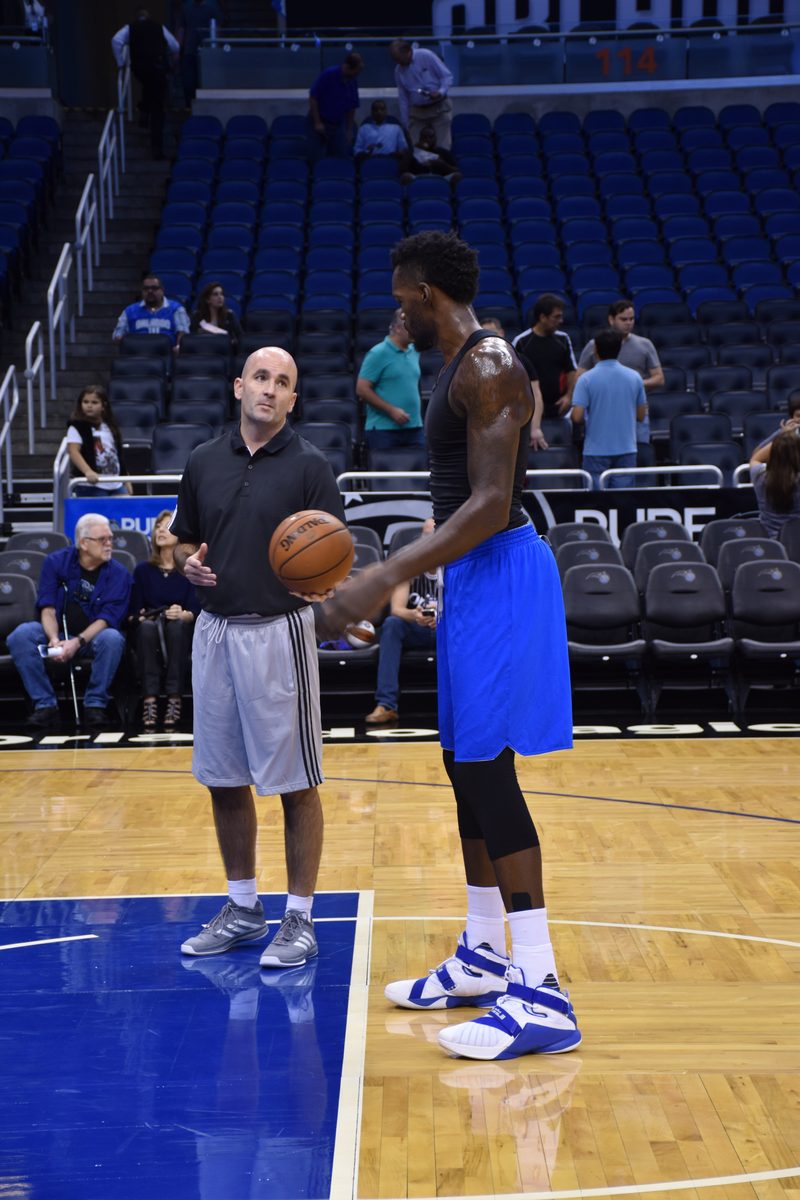
When Dewayne walked back into the gym before training camp, he'd changed his shot. It wasn't a finished product — but the old set point was gone. He'd moved off his old, dysfunctional habit and started to stabilise a new one.
Other coaches started to notice — first that it looked different, then that a career sub-55% free-throw shooter was suddenly making a lot of them, in workouts and then in games. A couple of injuries opened up minutes early that season, and Dewayne shot 69% from the line in November. His playing time dipped in December and January, but when he got another run in February and March, he made nearly 80% (27 of 34).
He finished that season at 75% from the free throw line. And it kept going. Dewayne put together seasons at 81% and 83% from the line — and a big man who had attempted essentially zero three-pointers through his first four seasons became a genuine floor-spacer, shooting 38% from three on real volume at his peak.
A third-string center who couldn't be trusted to shoot turned himself into an 80% free-throw shooter with NBA three-point range. Learn how Coach Dave Love and Dewayne Dedmon rebuilt his shot.
ShareWhat actually made the difference
Dewayne was generous enough to credit the work we did together. I'd give him more of it than he'd give himself — the diagnosis and the design were mine, but the rebuild was his, rep after rep, mostly out of my sight. Four things made it work:
- An accurate diagnosis. Reading the flat ball back to a single cause — the set point — instead of guessing at the whole motion.
- Constraints that taught. Drills that made the old habit hard and the new one easy, so he could self-correct without a coach in the room.
- Clear guardrails. Knowing exactly where he was free to explore and where he had to stay disciplined.
- The player's ownership. Months of honest, correct work with no one standing over him.
It's the case I point to whenever someone assumes a shooter can only be rebuilt with a coach standing next to them. Sometimes the most important reps are the ones a player takes on their own.
“You can diagnose a shot and design the work, but the player is the one who has to rebuild it — rep after rep, on his own.”
Tweet thisReferences
- Dewayne Dedmon — NBA career statistics and 2015–16 monthly splits. Basketball-Reference.com. (2014–15 FT% .531; 2015–16 FT% .750, Nov .696, Feb–Mar 27/34; later seasons .814 and .833; 3P% .382 on 3.4 attempts/game in 2018–19.)
- Dewayne Dedmon — college and pro splits. Sports-Reference / Basketball-Reference.com.