For a good part of my career, including years working in the NBA, I had no idea that "how people learn skills" was a field of study. I coached on feel. I used what I had been taught, what I had seen work, and what looked right in the moment.
It never crossed my mind that researchers had spent close to a hundred years studying the exact thing I was doing on instinct, filling academic journals with findings that could have reshaped how I ran a single practice. Finding that research is a big reason I went back to school. I am in the final year of a Master's in Skill Acquisition, and along the way I have been fortunate to contribute to peer-reviewed work. I did not do it because a coach needs a degree to be good. Plenty of excellent coaches have never opened a journal. I did it because I wanted to actually understand the thing I had been doing by gut for years.
The trouble is that this research is genuinely hard to get into, and I think that is why so few coaches have. The language is academic. The major theories openly contradict each other, and both camps can point to evidence. A lot of it can also leave an experienced coach feeling like their hard-won intuition is being written off as guesswork, and ineffective. So I want to do here what I wish someone had done for me: lay out the landscape in plain terms, honestly, from the point of view of a coach who is still in the gym every day.
“Most coaches aren't wrong. They may just be working from an old skill-acquisition map while the territory has been redrawn.”
Tweet thisSo what is skill acquisition?
Skill acquisition is the science of how people learn, control, and adapt movement skills. It studies what actually changes in a performer as they get better, and what conditions make that change last.
Why should a coach care? Because every choice you make in practice is a bet about how learning works. How you explain a shot. How you order your reps. How much you correct, and when you add a defender or a clock. Skill acquisition is the study of which of those bets tend to pay off, and which ones feel productive while quietly wasting your players' time. It will not give you a script, but it will sharpen your eye.
A hundred years, and two ways of thinking
Strip away the jargon and a century of research comes down to one question: where does skill actually live? Two answers took shape, and one of them evolved a great deal along the way.
Answer one: skill lives in a model your brain builds. This is the cognitive tradition, and it did not stand still. Its early form was the information-processing view: the brain as a computer that takes in information, selects a response, and sends out a command. In practice that became "teach the correct technique, then repeat it with feedback until it's engrained" which is roughly what the motor-learning researcher Jack Adams proposed in his closed-loop theory: feedback and repetition strengthen an internal reference of the correct movement. But that could not explain how a player makes a shot they have never rehearsed, so the tradition evolved. In 1975 another motor-learning researcher, Richard Schmidt, put forward schema theory: we do not store individual movements at all. We build an abstract rule, a schema, and we sharpen it through variety. The prediction was ahead of its time: practicing a skill many different ways builds a more flexible, more robust skill than grooving it one way. If "variability of practice" sounds like a modern idea, note that it came from the cognitive camp first. Even Schmidt himself, 27 years later, took an honest inventory of the evidence, kept what had held up, and called for a new theory to replace the rest.
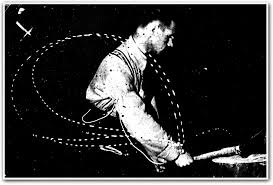
Answer two: skill does not live inside you at all. The ecological tradition threw out the internal model. The idea traces back to the Russian physiologist Nikolai Bernstein, who noticed decades ahead of his field that no two skilled movements are ever quite identical, and to the American perceptual psychologist James Gibson, whose ecological psychology held that we perceive the world directly, in terms of what it lets us do. Add dynamical systems theory, the principle that complex movement organizes itself, and you have what is now called Ecological Dynamics. Its claim: movement emerges in the moment from the fit between the player, the task, and the environment. You do not hand a player a model to store. You shape the conditions and let a solution take shape.
“Practice is a particular type of repetition without repetition.”
Where CLA fits in
A term you have probably heard fits right here. The Constraints-Led Approach (CLA) is a coaching model inside Ecological Dynamics. It builds on a model from the movement scientist Karl Newell, who framed every movement as shaped by three kinds of constraints: the task, the environment, and the individual. Manipulate those well, and a player finds a functional solution without being walked through it step by step. CLA is a tool inside a theory, not the theory itself, and treating the two as the same thing is where a lot of the confusion in basketball begins. (I have written separately about how CLA gets misread in our sport.)
Where we stand now
So where does that leave us? Honestly, in an unsettled place, and anyone who tells you otherwise has picked a side. Ecological Dynamics has the momentum in applied coaching right now, and for good reason. It takes the mess of real sport seriously in a way many older studies did not. But the cognitive tradition is far from finished. It still holds real evidence on things like attention and practice scheduling. Both camps are holding real cards.
Take a player whose base keeps failing them, the feet too narrow to stay balanced through the shot. The three traditions would attack it three different ways, and the real picture is not old versus new. It is three distinct bets a coach can still make on the very same problem.
Here's where I'll show my hand, because pretending all three are equally right would be its own kind of dishonesty. As a theory of how a game shot is learned, information processing is the weakest of the three. A real shot is never taken twice the same way: a defender crowds you, you catch off balance, the angle is one you've never rehearsed. A view built on storing and replaying the correct movement struggles to explain how a player makes that shot at all. For open, in-game skill, I think it's fair to say the field has moved on, and so have I.
But a weak theory is not the same as a useless one. Even the information-processing tradition left behind tools worth keeping: a little instruction to get a beginner organized, and some of the most reliable findings we have about where to put a player's attention and how to space their reps. The mistake was never using those tools. The mistake is treating a tool that happens to work as proof that the theory behind it is true.
“A weak theory can still hand you a useful tool. The mistake is treating the tool as proof the theory is true.”
Tweet thisSo it isn't that all three are equally right. It's that even the weakest theory can still hand you something useful in the right moment, and the strongest can still be misapplied. The job is knowing which is which, and choosing for the player in front of you.
An honest look at the evidence
This is the part I most wish someone had told me early. A great deal of the research on both sides was run in narrow conditions: often with beginners, on simple laboratory tasks like pressing keys or tossing beanbags, over short windows, and measured with transfer tests that look nothing like the sport. That is not a criticism of the researchers. It is how you get clean, controlled data. The problem is what happens next. Findings from those narrow slices get carried into elite sport and applied with total confidence, very often by the people who have read the least of the actual work.
You do not have to take my word for it. In 2002, motor-learning researchers Gabriele Wulf and Charles Shea published a review with a title that says the quiet part out loud.
“Principles derived from the study of simple skills do not generalize to complex skill learning.”
Wulf is one of the most cited names in the field, and that was a warning from inside the house, not a shot from the ecological camp. Systematic reviews since have kept finding the same pattern: most studies use novices on simple tasks over short periods, with very little work on refining the skills of already-good performers.
So when someone tells you "the science says," on either side, the fair questions are: which science, run on whom, measured how, and does that setting look anything like a gym full of the players you actually coach?
To take the most common leap: the fact that an approach helped novice players pick up a new skill is not the same as evidence that it will help a mature player, one who has always struggled with that skill, relearn it. Those are very different problems, and most of the research only ever tests the first.
“The evidence is real. It is also thinner, narrower, and more contested than the confident voices online let on.”
Tweet thisGood coaching lives inside that uncertainty, not above it.
CDL Coaching Toolbox
The measurements behind how I read and build a shot, put in your hands to use on your own players. Free to try.
Where I land
For what it is worth, I lean ecological in my own coaching. It fits how I see the game, what I think it means to be skilled, and how I have watched players actually develop. But I do not think any coach is ever fully one theory, and I would be wary of one who claimed to be. Ecological Dynamics is a theory, a map rather than the territory. And I am not coaching a theory. I am coaching real people who show up with their own beliefs, preferences, and comfort zones. There are times when the right move is to step away from an ecological approach to meet a player where they are. There are even times when another approach gets a player just as far a little faster, before a subtle pivot back is needed. Either way, my job is to notice it and find my way back as quickly as I can.
I'll be honest about something else, too. There is no rule book for how to coach within any one of these theories. Thoughtful, well-read coaches disagree all the time about whether a given idea fits a model or breaks it, and often both of them have a defensible case from where they stand. I don't see that as a weakness in the field. As long as we keep having those conversations, we all come out further ahead than where we started.
None of that is a betrayal of the science. It is the science, put to work by someone who respects both the research and the human in front of him. Ed Coughlan, who holds a PhD in skill acquisition and has been a mentor of mine, says it better than I can.
“It isn't our job to coach with one particular motor learning theory. Our job is to understand the theories and select the best tool for the job that is in front of us.”
That is what this whole part of my work is about. Not selling you a method, but helping you understand the landscape well enough to choose well, one player, one problem, one practice at a time.
References
- Bernstein, N. A. (1967). The Co-ordination and Regulation of Movements. Pergamon Press.
- Gibson, J. J. (1979). The Ecological Approach to Visual Perception. Houghton Mifflin.
- Newell, K. M. (1986). Constraints on the development of coordination. In Motor Development in Children: Aspects of Coordination and Control.
- Schmidt, R. A. (1975). A schema theory of discrete motor skill learning. Psychological Review, 82(4), 225–260.
- Schmidt, R. A. (2003). Motor schema theory after 27 years: Reflections and implications for a new theory. Research Quarterly for Exercise and Sport, 74(4), 366–375.
- Wulf, G., & Shea, C. H. (2002). Principles derived from the study of simple skills do not generalize to complex skill learning. Psychonomic Bulletin & Review, 9(2), 185–211.