Every NBA season, some version of the same story plays out. A player whose shot has worked against them for years commits to changing it. The work in the gym looks good. A few weeks later, in a game, the old shot is back, sometimes as if nothing ever changed.
It would be easy to blame the player or the coach. I don’t think that’s usually the real story. Changing a stable movement pattern at this level is genuinely hard, and the reasons are well described in skill acquisition and coordination dynamics research. This post is my attempt to understand that problem: why it happens, what the research can and can’t tell us, and how I think about it when I’m the one trying to help.
Rebuilding a shot comes down to three things: how hard it is to break the old habit, how long it takes to build the new one, and how much variability can be added along the way. Underestimate or overestimate any one of them, and progress can stall, even when everything else is done well.
A habit is a valley
Coordination dynamics, the science of how movement patterns form and change, describes a habit as an attractor: a pattern the body keeps settling into. A useful way to picture it is a landscape. Each way of shooting is a valley, and the player’s shot is a ball that rolls into the nearest one. How stable a habit is just means how deep its valley is.
A shot that has been repeated for ten or fifteen years has carved a very deep valley. That’s why it holds up when the player is tired, rushed or not thinking about it at all. The problem is that depth doesn’t care whether the habit is functional. A stable, dysfunctional pattern is still stable.
The research is also clear that no player is a blank slate. When people learn a new coordination pattern, they don’t write it onto empty space. They learn it on top of the tendencies they already have, and those tendencies either help the new pattern or compete with it (Zanone & Kelso, 1992; Kostrubiec et al., 2012). When the new shot is far from the old one, you’re not just building something new. You’re in a competition with something old.
1. How long a new habit takes to stabilize
The first thing to get right is the timeline, because almost every other mistake follows from underestimating it.
Start with what a good session actually tells you. Motor learning research draws a sharp line between performance (what you see during practice) and learning (what’s still there days later, in new situations). The two often disagree. Players can look dramatically better at the end of a session without much lasting change, and real learning can happen while practice looks messy (Soderstrom & Bjork, 2015). A great Tuesday workout is encouraging. It isn’t proof.
So how long does real change take for skilled performers? There are only a few studies that track technique change in elite athletes over time, but they point the same way:
- Three elite golfers each worked on a single swing refinement. For the golfer who succeeded, the intervention ran about six months. Another changed his technique but never got it back to automatic. A third didn’t finish because his competitive season arrived first (Carson & Collins, 2015).
- Highly skilled tennis players described spending one to four years on a single technical change, and several fell back to the old technique, or a hybrid of old and new, the first time they used it in competition (Toner et al., 2020).
- The authors of the most-used framework for this work, the Five-A model, suggest the full process can take up to a year depending on the sport and the size of the change (Carson & Collins, 2016).
None of these are NBA shooters, and I haven’t found a study that tracks a shooting change in skilled players. But the direction is consistent and it matches what I’ve experienced in my career: changing an established pattern in a skilled performer is measured in months, not weeks. Now set that against an NBA calendar: a few months of offseason, then games every other night, travel, and a player who has to produce now.
One more thing worth saying plainly: there is no magic number. The “21 days to form a habit” idea comes from a 1960 self-help book, not motor learning research, and I’ve never found a source behind the popular “3,000 reps to fix a habit” line. Anyone who tells you exactly how long a shot change will take is guessing.
“A great workout during a shot change is encouraging. It isn’t proof. Real change is what’s still there days later, in a game.”
Tweet this2. The pull of the old habit
The second problem is that the old valley doesn’t disappear just because the player has started digging a new one. Learning a new pattern doesn’t erase the old one. The new pattern has to out-compete it.
One of the most useful studies here found two different ways people learn a new coordination pattern (Kostrubiec et al., 2012). Some learners gradually bent their existing pattern toward the target. It looked like learning, but a month later those learners couldn’t reproduce the new pattern and had drifted back toward their old tendency. Others built a genuinely new stable pattern. That version held a month later, but it took more attention to get there.
That distinction matters for shooting. A player can look like they’ve changed, when really they’ve just leaned the old shot a little in the right direction. Under the surface, the old valley is still the deepest one on the map.
Two more things keep pulling the player back:
- Familiar conditions keep reinforcing the old habit. Stable patterns don’t destabilize themselves. If the player keeps practicing in conditions that look just like the ones that built the old shot (same spots, same rhythm, same catches), the theory predicts the old valley will stay deep. That’s why coaches often have to deliberately disrupt a pattern before a new one can form (Ranganathan & Newell, 2013).
- Speed and pressure tilt the landscape. In the classic coordination experiments, speeding a movement up pushed people out of a less stable pattern and into a more stable one, without them choosing to switch (Kelso, 1984; Haken, Kelso & Bunz, 1985). Pressure works in a similar direction: a newly changed technique is more fragile under competitive stress than one that has been established for years (Carson & Collins, 2016).
Then there’s a part I think coaches underestimate. In the same coordination research, once a movement had been pushed into the more stable pattern, slowing back down didn’t return it to where it started. It stayed in the stable pattern. This is called hysteresis: where you end up depends on the path you took to get there. For a shot change, it means that once a player falls back into the old shot in a game, they often stay in it even after the pressure eases. The bad quarter doesn’t end when the moment that caused it does.
Put those together and you get the “one step forward, one step back” pattern I see so often. The player does good work in a workout, then goes into other drills where the old shot wins, and every rep with the old shot is another rep digging the old valley a little deeper. Nobody intends it, but it’s easy to accidentally reinforce the exact habit you’re trying to break.
“Learning a new shooting habit doesn’t erase the old one. The new one has to out-compete it, especially when the game speeds up.”
Tweet this3. How much variability, and where
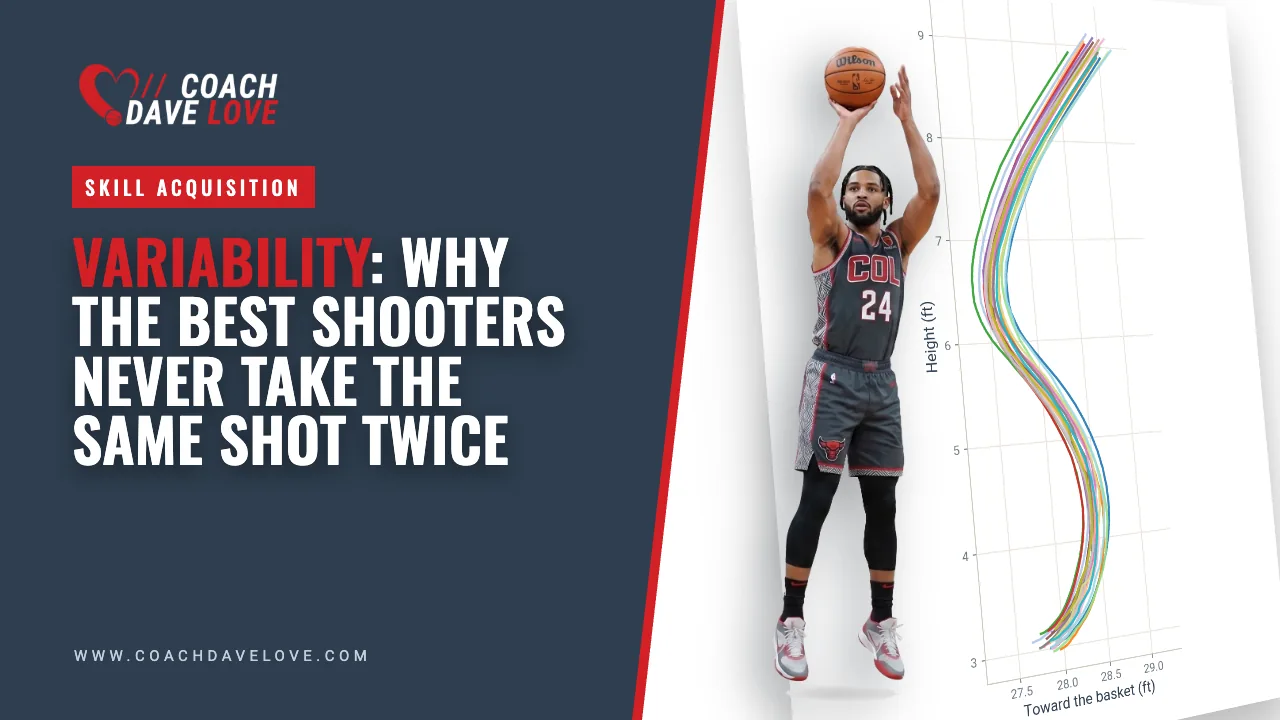
The third problem is the one I find hardest to get right. A new habit built only in a quiet, repetitive drill won’t survive a game; I’ve written about that in Variability and Stabilizing the Foundation. But add too much variability too early and the new pattern falls apart, or the old one takes over.
The research supports that tension. Variability in practice has a sweet spot: too little and too much both hurt learning (Ranganathan, Lee & Newell, 2020). Reviews of this work suggest keeping deliberate variation low while a learner is still finding the basic structure of a new movement, adding it in small, systematic steps rather than random ones, and using it on purpose to shake a learner out of a stuck solution (Hossner & Zahno, 2022). In one study, small differences from one rep to the next helped learning more than large, random ones (Hossner, Käch & Enz, 2016).
What I haven’t found is a study that directly tests what coaches actually need to know: how much can I vary everything else while one part of the shot is stabilizing? So this part is how I apply the research, not something it has proven:
- Vary the parts furthest from the change first. Spot on the floor, type of catch, footwork into the shot, the rhythm of the drill. Leave the part you’re changing as protected as you can, for now.
- Remember the shot is connected. In a basketball free-throw study, the elbow and wrist appeared to compensate for each other near release (Button et al., 2003). Changing range or force demands can pull on the very part you’re trying to stabilize. “Everything else” isn’t a set of independent dials.
- Use the new habit as your gauge. If it holds, nudge the variability up a little. If it starts to slip or the old pattern shows up, ease off. This is the challenge point idea applied to a shot change.
- Expect it to get messier before it gets better. Coordination research has found a burst of increased variability right before a new stable pattern forms (Kostrubiec et al., 2012). Some messiness is a sign of change, not failure. The hard part is telling that apart from the old habit winning, which is why it’s worth watching the part you’re changing, not just makes and misses.
Knowing When to Progress
The phase landmarks I use to decide when a new habit is stable enough to add challenge, with the signs to look for at each step.
The Five-A model, through an ecological lens
The most complete framework I know for changing technique in experienced athletes is the Five-A model (Carson & Collins, 2011). It was built for exactly this situation: a skilled performer with an established technique who needs to change part of it and have that change hold up under pressure. In brief:
- Analysis: decide whether, when and what to change, and make sure the change targets the real cause of the problem.
- Awareness: deliberately bring the old habit back into conscious awareness, usually with contrast drills that alternate the old way and the new way.
- Adjustment: gradually shift the balance toward the new version while reintroducing normal practice conditions.
- (Re)Automation: move the change back out of conscious control, using whole-movement rhythm cues and practice under more realistic conditions.
- Assurance: pressure-proof the change with competition-like challenge, and build the athlete’s trust that it will hold.
Carson and Collins built this largely from a cognitive, conscious-control standpoint. But when I read it through an ecological dynamics lens, four of the five A’s translate fairly naturally, and I want to be clear that this is my reading, not theirs:
- Analysis becomes an analysis of the player, the task and the environment together, rather than a comparison against an ideal model. Carson and Collins already warn against copying an “expert model.”
- Adjustment becomes constraint manipulation: shaping the task so the new solution is the one that works. They compare this stage to differential learning themselves.
- (Re)Automation becomes stabilizing a new attractor, digging the new valley deep enough that the player doesn’t have to hold it there consciously.
- Assurance becomes representative, pressure-loaded practice, so the new habit is tested where the old one usually wins.
That leaves Awareness, which at first looks like the odd one out. It’s the stage that sits most uncomfortably with constraints-led coaching advice, which generally favors an external focus and minimal instruction.
But I think it may be the piece that unlocks this problem, and it has a better home in the theory than it first appears. In coordination dynamics, a person’s intention isn’t outside the system. It acts on the existing landscape as information, pulling behavior toward the intended pattern (Kelso, 1995). Experiments on deliberately switching between movement patterns found that intention can change which pattern you’re in, but how easily depends on how stable each pattern is (Scholz & Kelso, 1990). That’s a precise description of a player fighting an entrenched shot. Carson and Collins built their Awareness stage on this same line of research.
Contrast drills, old way then new way, give the player something they often don’t have: the ability to feel both valleys and choose between them on purpose. Researchers studying expert performers have argued that skilled athletes may need this kind of deliberate bodily awareness to keep improving (Toner & Moran, 2015). It’s hard to climb out of a valley you can’t feel you’re in.
The catch is that awareness has to be temporary. Consciously controlling a movement tends to break down under pressure (Masters, 1992), and an internal focus generally performs worse than an external one (Wulf, 2013). So awareness is a tool for getting the change started, not a way to play. It has to fade, which is exactly why Carson and Collins follow it with Adjustment and (Re)Automation.
To keep this honest, the evidence doesn’t all point one way. Carson and Collins argue that purely constraints-based coaching is less likely to make a change permanent and pressure-proof. But in baseball, a constraints-led intervention raised hitters’ launch angle more effectively than verbal cues did (Gray, 2018). I don’t read that as one side winning. I read it as more evidence that this isn’t a problem one camp gets to solve alone.
“It’s hard to climb out of a habit you can’t feel. Awareness of the old shot may be what lets a player choose the new one, as long as it fades.”
Tweet thisWhat this means for a coach
None of this makes the problem easy. But it does change how I plan for it:
- Plan the window before you start. A meaningful change needs months. If the calendar doesn’t allow that, it may be better to make a smaller change, or to wait for a window that does.
- Judge change by what holds, not what happens in the session. Check it days later, in new drills, and eventually in games.
- Know where the old habit wins. Speed and pressure are well documented. In my experience, fatigue belongs on that list too. Build up to those conditions deliberately instead of finding out about them in a game.
- Expect games to pull the player back, and have a plan for it. A bad night with the old shot isn’t the end of the change, but it is information.
- Add variability away from the change first, and let the new habit tell you when to add more.
- Use awareness on purpose, and briefly. Contrast the old and the new so the player can feel the difference, then fade toward whole-shot rhythm and external cues.
An honest problem
When a shot change doesn’t stick in the NBA, it’s rarely because someone didn’t work hard enough. It’s usually because a deep, stable habit was asked to give way on a timeline that didn’t allow it, in conditions that kept tilting the landscape back toward it.
This post is my attempt to understand that problem better, not to claim I’ve solved it. Some of what I’ve described is well supported by research; some of it is my reading of that research through years of trying to help players in this exact situation. I’d genuinely like to hear how other coaches think about it.
If you want to see what this looks like with a real player, the Aaron Gordon case study walks through one change from start to finish.
References
- Button, C., MacLeod, M., Sanders, R., & Coleman, S. (2003). Examining movement variability in the basketball free-throw action at different skill levels. Research Quarterly for Exercise and Sport, 74(3), 257–269.
- Carson, H. J., & Collins, D. (2011). Refining and regaining skills in fixation/diversification stage performers: The Five-A model. International Review of Sport and Exercise Psychology, 4(2), 146–167.
- Carson, H. J., & Collins, D. (2015). Tracking technical refinement in elite performers: The good, the better, and the ugly. International Journal of Golf Science, 4(1), 67–87.
- Carson, H. J., & Collins, D. (2016). Implementing the Five-A model of technical refinement: Key roles of the sport psychologist. Journal of Applied Sport Psychology, 28(4), 392–409.
- Carson, H. J., & Collins, D. (2016). The fourth dimension: A motoric perspective on the anxiety–performance relationship. International Review of Sport and Exercise Psychology, 9(1), 1–21.
- Gray, R. (2018). Comparing cueing and constraints interventions for increasing launch angle in baseball batting. Sport, Exercise, and Performance Psychology, 7(3), 318–332.
- Haken, H., Kelso, J. A. S., & Bunz, H. (1985). A theoretical model of phase transitions in human hand movements. Biological Cybernetics, 51(5), 347–356.
- Hossner, E.-J., Käch, B., & Enz, J. (2016). On the optimal degree of fluctuations in practice for motor learning. Human Movement Science, 47, 231–239.
- Hossner, E.-J., & Zahno, S. (2022). Beyond task-space exploration: On the role of variance for motor control and learning. Frontiers in Psychology, 13, 935273.
- Kelso, J. A. S. (1984). Phase transitions and critical behavior in human bimanual coordination. American Journal of Physiology: Regulatory, Integrative and Comparative Physiology, 246(6), R1000–R1004.
- Kelso, J. A. S. (1995). Dynamic Patterns: The Self-Organization of Brain and Behavior. MIT Press.
- Kostrubiec, V., Zanone, P.-G., Fuchs, A., & Kelso, J. A. S. (2012). Beyond the blank slate: Routes to learning new coordination patterns depend on the intrinsic dynamics of the learner. Frontiers in Human Neuroscience, 6, 222.
- Masters, R. S. W. (1992). Knowledge, knerves and know-how: The role of explicit versus implicit knowledge in the breakdown of a complex motor skill under pressure. British Journal of Psychology, 83(3), 343–358.
- Ranganathan, R., & Newell, K. M. (2013). Changing up the routine: Intervention-induced variability in motor learning. Exercise and Sport Sciences Reviews, 41(1), 64–70.
- Ranganathan, R., Lee, M.-H., & Newell, K. M. (2020). Repetition without repetition: Challenges in understanding behavioral flexibility in motor skill. Frontiers in Psychology, 11, 2018.
- Scholz, J. P., & Kelso, J. A. S. (1990). Intentional switching between patterns of bimanual coordination depends on the intrinsic dynamics of the patterns. Journal of Motor Behavior, 22(1), 98–124.
- Soderstrom, N. C., & Bjork, R. A. (2015). Learning versus performance: An integrative review. Perspectives on Psychological Science, 10(2), 176–199.
- Toner, J., Carson, H. J., Collins, D., & Nicholls, A. R. (2020). The prevalence and influence of psychosocial factors on technical refinement amongst highly-skilled tennis players. International Journal of Sport and Exercise Psychology, 18(2), 201–217.
- Toner, J., & Moran, A. (2015). Enhancing performance proficiency at the expert level: Considering the role of ‘somaesthetic awareness’. Psychology of Sport and Exercise, 16(1), 110–117.
- Wulf, G. (2013). Attentional focus and motor learning: A review of 15 years. International Review of Sport and Exercise Psychology, 6(1), 77–104.
- Zanone, P.-G., & Kelso, J. A. S. (1992). Evolution of behavioral attractors with learning: Nonequilibrium phase transitions. Journal of Experimental Psychology: Human Perception and Performance, 18(2), 403–421.