Every shooting coach has an opinion about a player’s rotation. Almost none of them can tell you what that rotation is actually reporting.
The spin of the ball is not something we care about for its own sake. It is a readout — a record of what the hand did in the last instant before the ball left it. Learn to read it and you are reading the release itself.
If you have ever sliced a golf ball, you have already read spin without knowing it. That ugly left-to-right curve is the ball reporting back that the club face was open and the swing cut across the target line. The golfer never sees the club face at impact; it happens far too fast. But the flight tells the story, because the spin tells the story.
Basketball works the same way, with one catch: the ball barely curves, so the game does not hand us the story in the flight. And the thing we most want to know — exactly how the fingers pushed the ball in the last fractions of a second — is so small and so fast that it is nearly impossible to measure directly. When I started down this road, company after company told me the fingers were simply too small to track reliably. But the ball is not too small. And the spin of the ball is a faithful record of how the hand pushed it. Measure the spin, and you have measured the hand.
“A sliced golf ball tells you the club face was open. The spin on a basketball tells you how the hand pushed it.”
Tweet thisWhat we actually want — and the real reason
Most coaches know they want pure backspin. Most cannot tell you why, beyond “it looks good” or “it goes in more.” Here is my reason, and it has almost nothing to do with the spin itself.
I want pure backspin because the move a player has to make to create it is the same move that sends the ball straight.
Think about what pure backspin actually requires: pushing both sides of the ball evenly, straight toward the target. That is it. And pushing both sides of the ball evenly, toward the target, is also the single best way to make the ball go where you are aiming. They are the same act. Pure backspin is just the visible fingerprint of a release that drove through the middle of the ball, on line.
Now break the symmetry. Push one side of the ball more than the other and the ball wants to leave to that side. To rescue the shot, the player has to make a second move — a correction that nudges it back on line. Those two moves, the uneven push and the save, combine on the ball as off-axis rotation. The bigger the moves, the harder they are to coordinate. And the bigger the two moves, the more the ball spins off axis. So the amount a shot spins off axis is really a measure of how much fighting-and-fixing happened in the release, and the direction of the tilt tells you which way the fight went.
“Pure backspin isn’t the goal. It’s the fingerprint of the one move that sends the ball straight — pushing both sides of the ball evenly, toward the target.”
Tweet thisThe axis of rotation
Picture a rod driven straight through the middle of the ball. The ball spins around that rod, and the direction the rod points is the axis of rotation. Pure backspin means the rod is perfectly horizontal and square to the target — the ball toppling straight back toward the shooter. Tilt the rod and you tilt the spin.
Here is the part that makes all of this usable: once the ball leaves the hand, that rod is essentially fixed. Nothing downstream changes it. Whatever the fingers did in the last instant is locked into the ball for the whole flight. That is exactly why the spin is such an honest witness — it is a snapshot of the release that cannot be edited after the fact. A baseball pitcher lives in this same world: the grip and wrist at release set the axis, and the axis decides whether the pitch rides like a four-seam or sweeps like a slider. The basketball is quieter about it, but the physics is the same.
The optical illusion of the seams
So if the axis is fixed and the spin tells the story, why can’t coaches just watch it? Because the seams of the ball lie to your eye.


Those two balls are spinning identically. No side-to-side tilt, no front-to-back tilt — pure backspin in both. The only difference is where the seams happen to sit relative to the axis. Yet most coaches would wave the first one through and fail the second. The rotation is perfect; the seams just are not advertising it.
“A basketball can be spinning perfectly and still look wrong. The seams fool the eye — they don’t change the shot.”
Tweet thisNow the reverse trap. Below is a real, small tilt — the axis leaning about ten degrees. With the seams aligned you might catch a slight lean, but only if the player happened to start with their hand square in the middle of a panel. With the seams unaligned you would never catch it at all. Grip the ball a little differently and pure rotation can look tilted, or a genuine tilt can hide completely.


Push the tilt to a dramatic forty-five degrees and, with the seams aligned, it is obvious. But that is not what you get in a game. Watch the same axis with the seams unaligned, in the roughly one-and-a-half seconds the ball is actually in the air, and you would never know. Shown two of these back to back, you would never guess they share the exact same axis of rotation.


This is the quiet scandal of coaching rotation by eye. Coaches know they do not like “bad” spin. They cannot reliably see what the spin actually is, and until recently they could not measure it. So the advice has been guesswork dressed up as observation — confident opinions about an illusion.
“Most coaches have been giving advice based on their opinions of an optical illusion. Players deserve better than that.”
Tweet thisSeeing it on the bullseye
To make this usable, we stop trusting the eye and put the axis on a target — a bullseye. We mark the bullseye with a dot where the axis of rotation leaves the right side of the ball, viewed from a side profile. Dead center is pure backspin. How far a shot sits from the center is how much it is spinning off axis; which direction it sits is which way the axis is tilted. Now every shot has a place on the target, and you can see at a glance whether a player is centered or scattered.

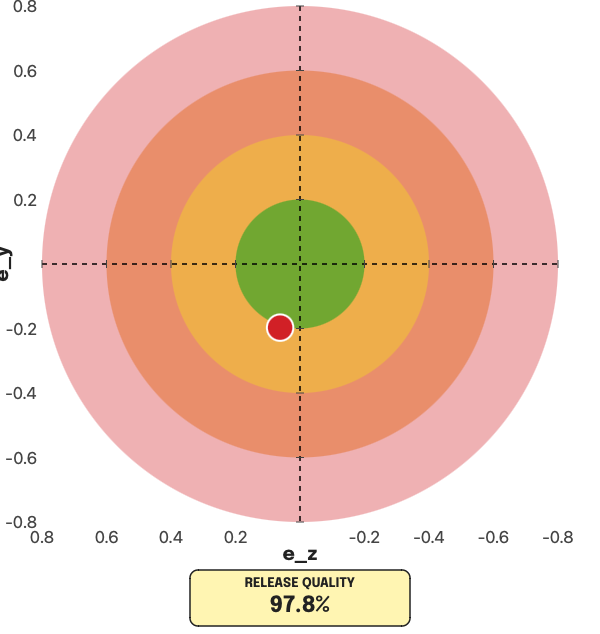
Direction matters as much as distance from center, because the two axes are not equally dangerous.
- Side-to-side tilt (eY) is the danger zone. Through the Magnus effect, a ball tilted this way curves left or right in the air — a miss the player cannot see and cannot feel, so they can only compensate by aiming off line, a little differently every time.
- Front-to-back tilt (eZ) is the safer zone. It makes the ball float a touch longer or drop a touch sooner. That still costs you, but the player compensates for depth naturally — see it hit front rim, add a hair more push next time — and that correction actually works.
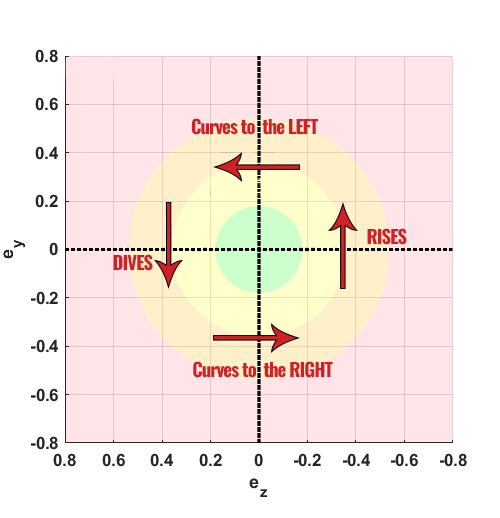
Two things scale the cost: the faster the ball spins and the longer it stays in the air, the more time a tilt has to bend the flight. Which is why this shows up most on NBA and deep college threes, and barely at all on a layup. A useful rule of thumb is about an inch of side-to-side curve for every six degrees of eY tilt — so a big lateral tilt on an NBA three can bend the ball half a foot off line, plenty to turn a swish into a rim graze. And because eY is the dangerous direction, a shot that is, say, 0.7 off axis all in eY is worse than the same 0.7 split between eY and eZ, where the lateral part is diluted across two directions.


CDL Coaching Toolbox
The Spin Axis and Ball Spin tools let you measure and visualize exactly what this article describes. Free to try.
From one shot to many
Here is where measurement pays off twice. Once you can put a number on a single shot — how far off axis, in which direction — you can put a number on twenty shots. Not just “was that one pure,” but how tightly does this player repeat the same release, shot after shot. That is a consistency score, and it is often more revealing than any single make.
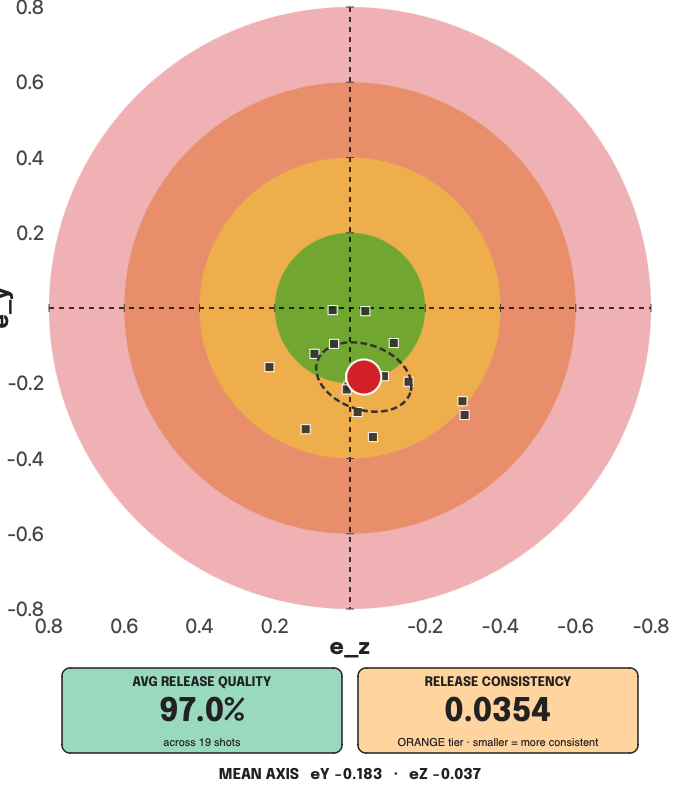
I have measured great shooters who carry a little more tilt than you would expect but repeat it almost perfectly, and weak shooters who can produce one gorgeous ball and then never the same way twice. An average hides that. The spread is the story. It is the same lesson as variability from the other side of the lens: what looks like consistency is really a release the player can reproduce on demand.
What the tilt reveals about the hand
This is where the number turns into coaching. Because the axis is a record of the hand, the direction of the tilt points back at what the fingers did.
- A +eY tilt can mean the player pushed the right side of the ball more than the left.
- A −eY tilt can mean they pushed the left side more than the right.
- A +eZ tilt can mean the push went to the right; a −eZ tilt, a push to the left.
Read that again and notice what it gives you. Not “your rotation looks a little off,” but a specific, testable read on which part of the hand did too much, and in which direction. That is something a coach can act on — a grip tweak, a footwork adjustment, an external cue like “make the ball spin purely” — and then measure again to see if it worked. It is detail the naked eye simply cannot deliver, on the part of the shot that happens too fast to watch.
What this does — and doesn’t — mean
A few honest guardrails, because measurement without judgment is its own trap.
Not every weak shooter has poor release quality. Plenty of players miss for reasons that have nothing to do with spin — balance, arc, footwork, decisions, confidence. Release quality is one instrument, not the whole diagnosis, and a beautiful axis does not make someone a shooter. But when a player does have poor release quality, that reading is gold: it points a knowledgeable coach straight at what to work on and how, instead of guessing.
And it cuts the other way, too. Because you can measure a shot before and after, you can finally test your own coaching. Run a drill, try a cue, change a grip — then check whether the numbers actually moved. The data does not just grade the player. It grades the practice.
“Measurement doesn’t just diagnose the player. It grades the practice.”
Tweet thisThe bottom line
Spin is not the point. Spin is the evidence. Pure backspin matters because the move that makes it is the move that sends the ball straight, and every degree a ball spins off that pure axis is a small confession about how the hand pushed it. For a long time coaches have squinted at that evidence through an optical illusion and called it a read. We can do better now. When you can measure how the ball leaves the hand, you stop guessing about the most important — and least visible — instant in the entire shot.