Most coaches invest significant effort into shooting development — conducting drills, dedicating practice time, and running repetitions. Yet many players fail to improve as expected. The issue typically isn't dedication but rather timing: players receive quality instruction at the wrong moments, or practice lacks a clear purpose.
Periodization solves this problem. This approach — planning and scheduling different training forms over time toward specific goals — appears routinely in strength training and distance running, but remains underutilized in basketball shooting instruction.
Why "just getting shots up" isn't enough
Typical practice incorporates form shooting, spot shooting from game locations, free throws between drills, and finishing work. While valuable individually, this work often lacks strategic intention. Coaches modify drills for variety rather than developmental progression. Timing frequently misaligns with purpose: form shooting precedes games while "game shots" populate offseason work.
Effective periodization doesn't eliminate existing drills; instead it positions them according to:
- The correct developmental phase
- Appropriate timing within weekly and seasonal schedules
- Individual player needs, intensity levels, and task constraints
The PoST framework for shooting
In 2019, goalkeeping coach Fabian Otte developed the Periodization of Skill Training (PoST) framework. In 2025, he and Coach Love adapted it specifically for basketball shooting.
The structure includes:
- Movement Coordination Training (MCT)
- Skill Adaptability Training (SAT) — with three sub-phases: SAT–Movement Variability (SAT–MV), SAT–Complex Training (SAT–CT), and SAT–Team-Based Training (SAT–TBT)
- Performance Training (PT)
Each phase targets different objectives, task-complexity levels, degrees of variability, and game-representativeness, positioned optimally relative to competition.
"Within an effective periodization shooting plan, there are no 'easy' phases. All forms of practice should be challenging, just in different ways."
Tweet this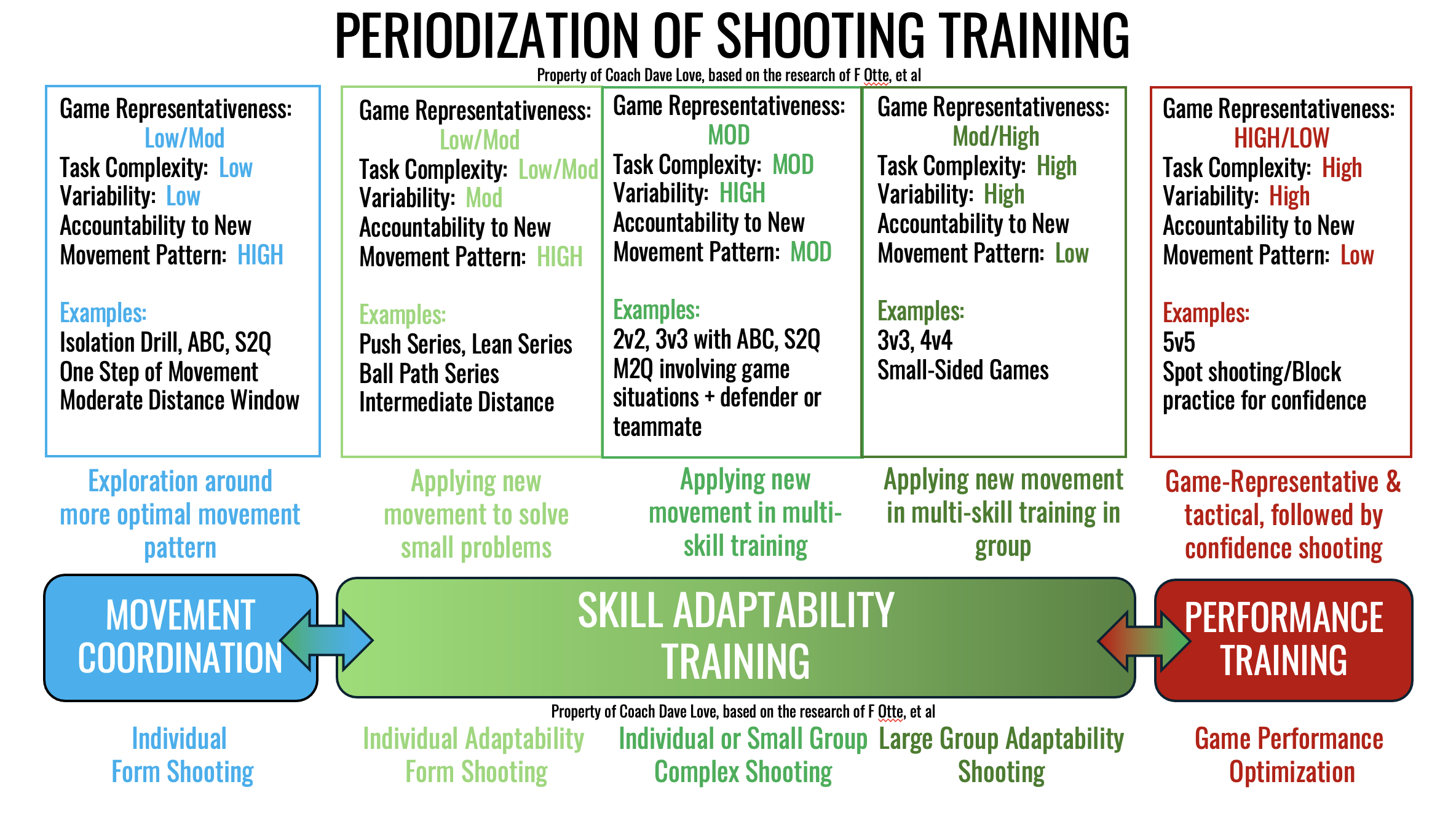
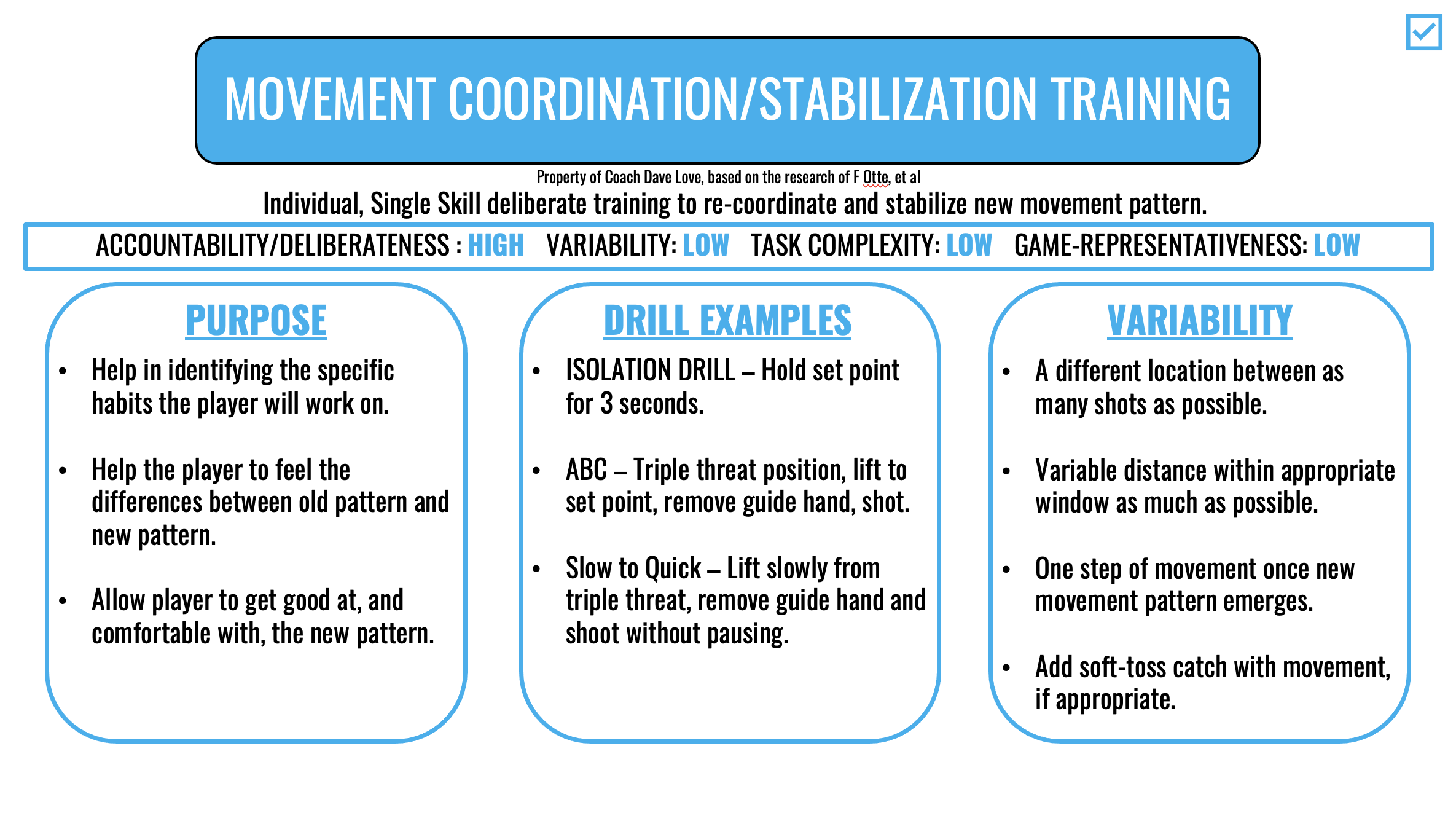
Movement Coordination Training: contemporary form shooting
Movement Coordination Training involves players exploring effective movement patterns within simplified environments scaled to individual needs — "contemporary form shooting" rather than prescriptive, motionless practice.
Key characteristics:
- Reduced complexity: fewer defenders (or none), simpler spacing, simpler decisions
- Game connection: realistic movement into shots, authentic passes, actual dribble pickups
- Specific physical-habit focus: balance, ball path, arc, release quality
- Applying differential learning, guided discovery, or constraints-led approaches to help players discover functional movement solutions
This phase proves especially valuable early in the offseason, earlier in the week (for weekend-game teams), and with developing shooters who need to reorganize mechanics without full-game complexity.
Skill Adaptability Training: making habits work under pressure
Skilled shooting extends beyond perfect repetition. Players must adapt movement patterns under increasingly realistic constraints — applying functional habits while overcoming game-like challenges. Three SAT sub-phases accomplish this.
The Periodization Workbook
Turn the PoST framework into a real plan — every phase, mapped across your season, week by week.
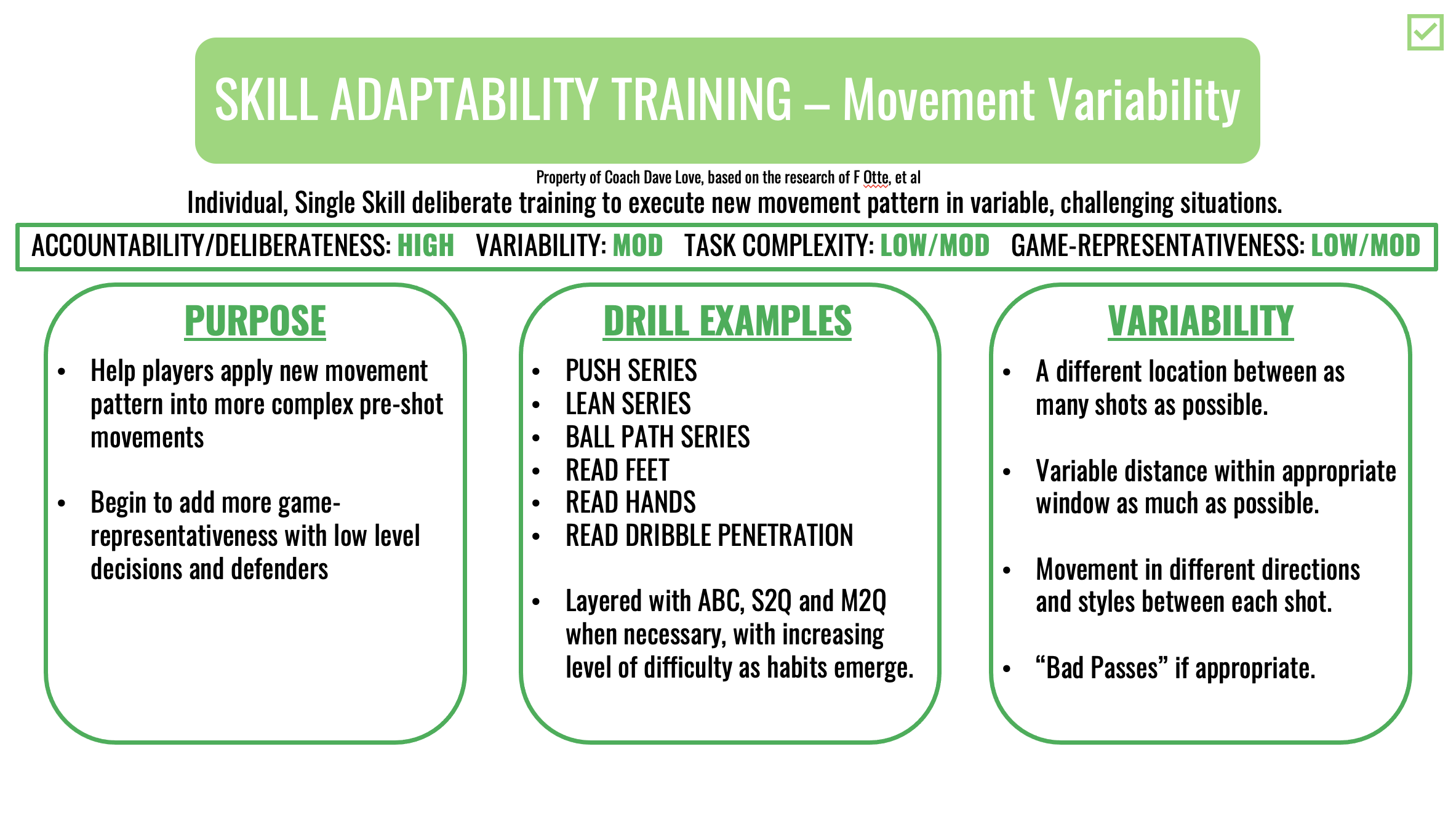
SAT–Movement Variability (SAT–MV)
Players encounter targeted challenges that disrupt clean execution: off-balance catches, difficult passes (low, high, wide), complex footwork or direction changes before the shot, varied dribble pickups under pressure. Coaches act as guided defenders — bumping, reaching, or forcing specific pickups. The environment remains relatively controlled yet eliminates perfect repetitions.
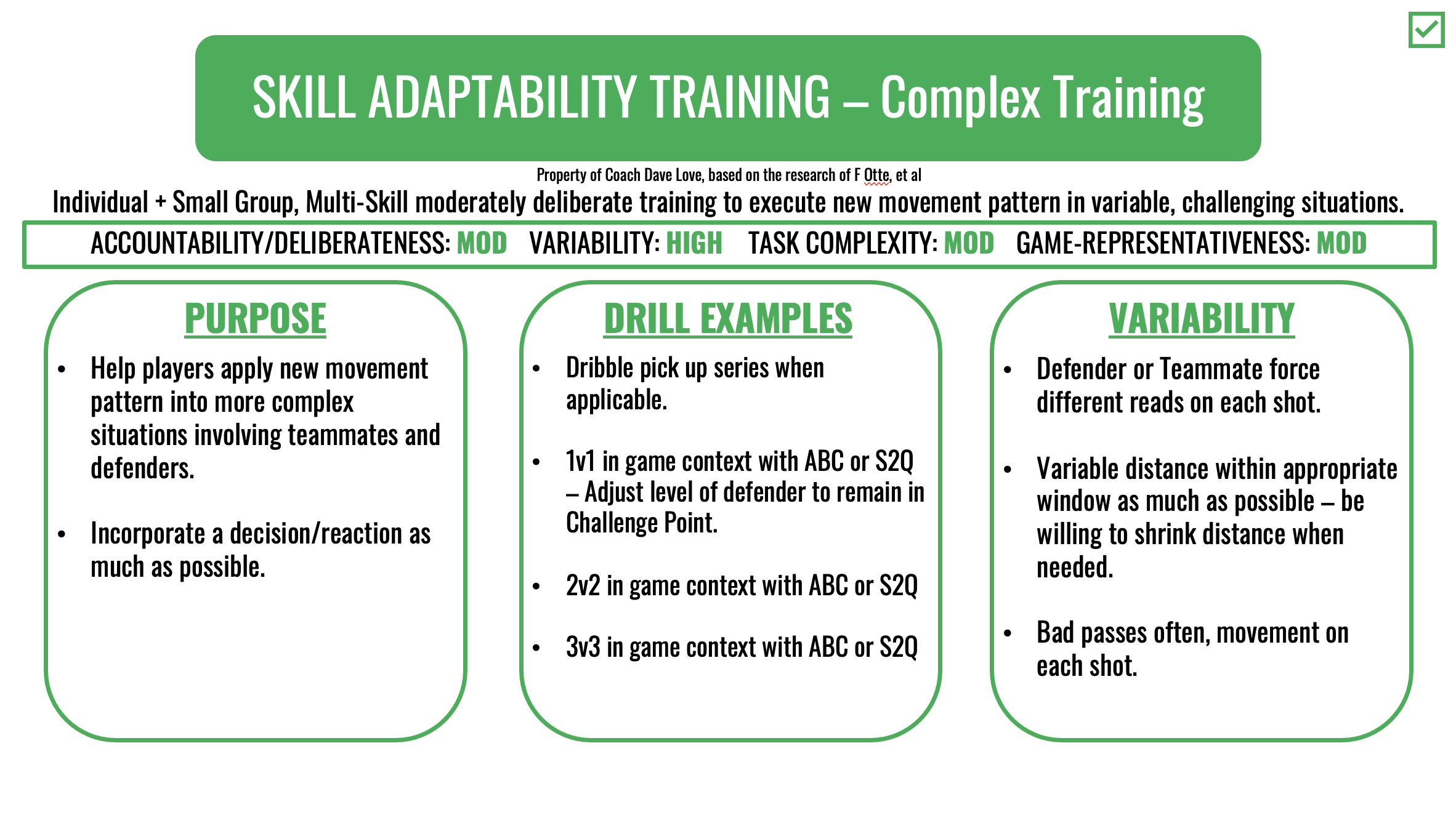
SAT–Complex Training (SAT–CT)
More game-like information emerges: multiple defenders, several teammates, simple decision frameworks (shoot/drive, use screen/reject). Players adapt improved movement patterns within situations where timing, spacing, and decision-making matter. This isn't full 5-on-5, but resembles 3v2, 2v2, or 3v3 small-sided games.
SAT–Team-Based Training (SAT–TBT)
Shooting integrates into broader team contexts: larger-sided games with tactical rules, team-offense segments emphasizing certain actions, transition games requiring relocation and firing in advantage moments. The shot becomes one element of a tactical puzzle. Players manage mechanics while handling reads, communication, and team concepts.
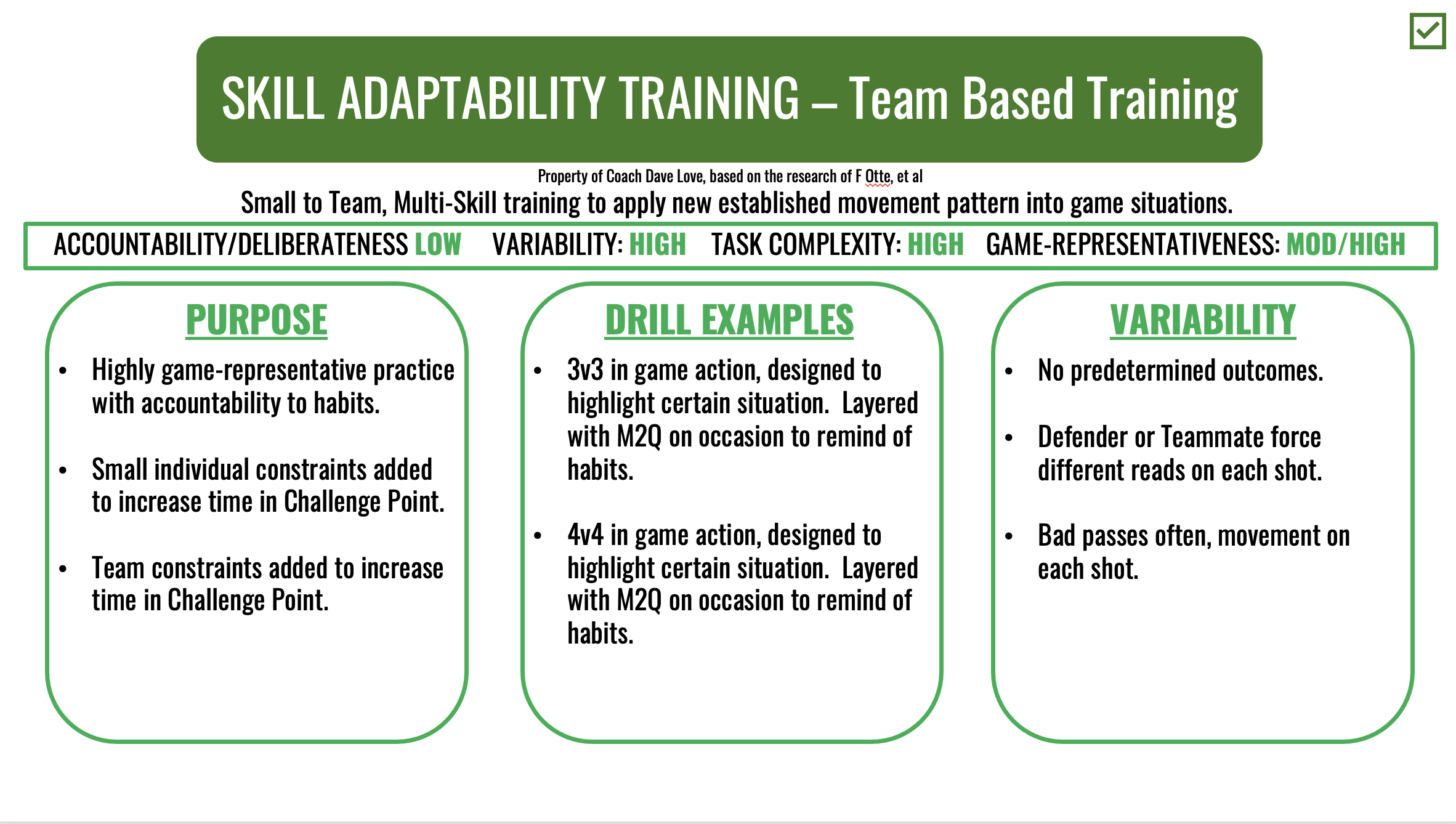
Throughout all three SAT phases, one theme persists: can you maintain functional movement patterns while the surrounding world becomes more game-like and less predictable?
Performance Training: tied to the game
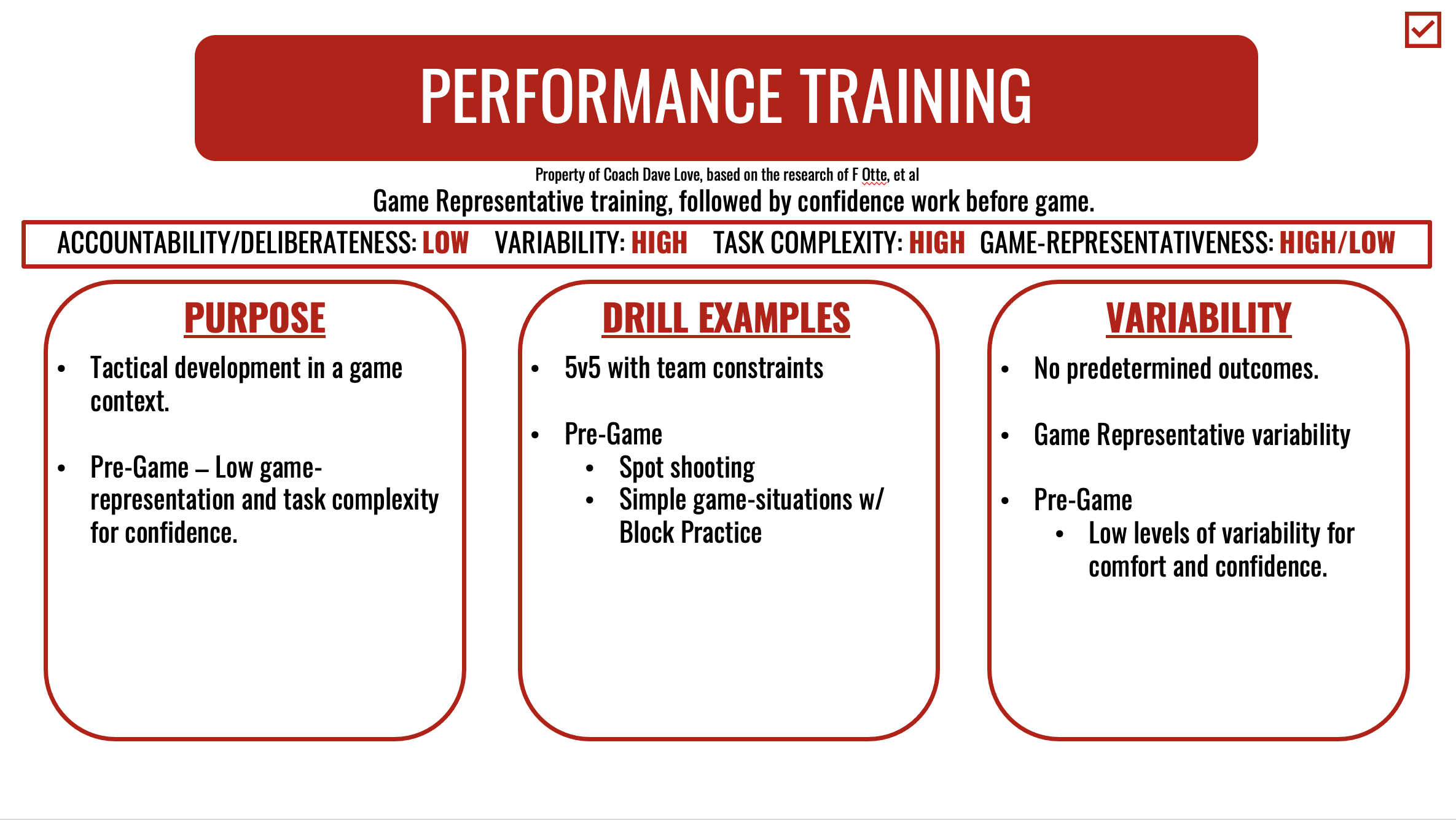
Performance Training represents the most game-like phase — live scrimmages, competitive activities nearly indistinguishable from actual basketball, situations emphasizing tactical and psychological demands.
This phase doesn't teach new movement solutions. Instead it asks:
“Can the player perform under the same constraints they'll face in games? Can they maintain their shooting behaviors when dynamic movement, bad passes, and defenders are all in play?”
Tweet thisFor established shooters, this phase gains greater emphasis. However, even experienced players benefit from periodic MCT and SAT work that maintains mechanically adaptable, non-rigid patterns.
One critical note: immediately pre-game is the only PoST sub-phase not focused on development. This is calibration time — players can substantially reduce complexity and challenge as they prepare for competition.
Matching phases to the calendar
Periodization always anchors to something — typically the competition schedule in team sports.
Macro-cycle: the big picture
For developing shooters, a basic macro plan might resemble:
- May–June: Emphasize MCT, introduce SAT–MV
- July–August: Increase SAT–MV, begin SAT–CT
- September: More SAT–CT, start SAT–TBT
- October: SAT–TBT plus early Performance Training
- In-season (Nov–April): Maintain habits with MCT, keep SAT sprinkled in, prioritize Performance Training
More advanced shooters spend less total MCT time but more time in complex SAT phases and Performance Training — though they still benefit from periodically revisiting simpler environments to refine habits.
Meso-cycle: 4–8 week blocks
Within that macro picture, zoom into 1–2 month phases. A May/June meso-cycle might start with mostly MCT, gradually shifting toward SAT–MV as habits stabilize. An October meso-cycle might incorporate weekly all-phase mixes, growing SAT–TBT and Performance emphasis as games approach.
Most shooting programs just repeat drills and hope. Learn how Coach Dave Love periodizes shooting development so skill actually holds up in games.
ShareMicro-cycle: the training week
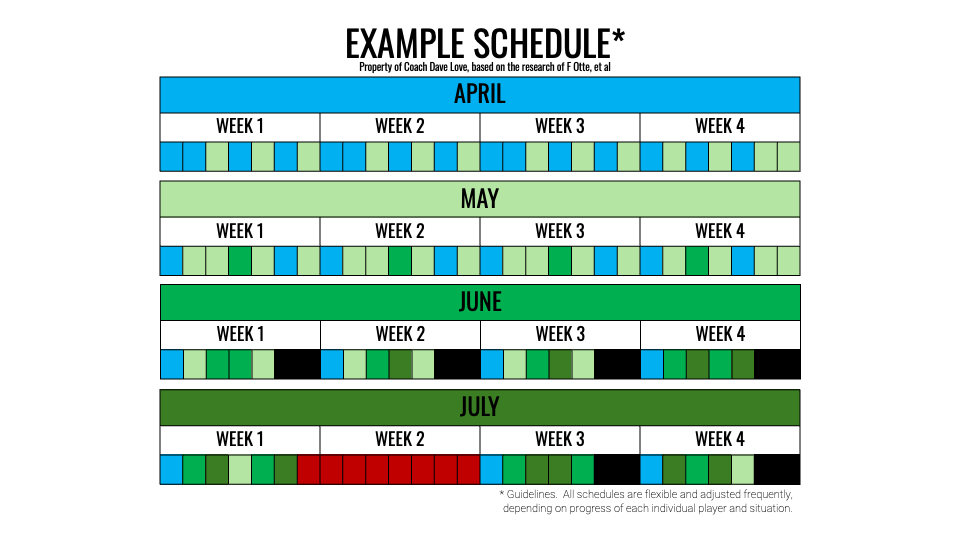
Weekly periodization becomes concrete. Example for a Friday/Saturday-playing team:
- Monday: Movement Coordination
- Tuesday: SAT–MV / SAT–CT
- Wednesday: SAT–CT / SAT–TBT
- Thursday: Performance Training
For a developing shooter within that same week:
- Monday: MCT focus
- Tuesday: MCT plus SAT–MV
- Wednesday: SAT–MV (simplified constraints)
- Thursday: Light SAT–CT plus a short Performance segment
No rigid rules exist here. The framework functions as a map, not a script. Real schedules are messy. The objective is simply more purposeful decisions about when each practice type appears.
Learning is non-linear
“Players don't 'graduate' from a PoST phase and never come back — they cycle in and out of them at appropriately scaled levels as they develop.”
Tweet thisPoST recognizes that learning happens non-sequentially. Players don't complete Movement Coordination and then permanently advance. Instead, they cycle through phases, extracting different information at various developmental moments, increasing the challenge within each phase as skill improves, and requiring different MCT / SAT / Performance ratios across stages.
For developing shooters, this means spending more total MCT and SAT–MV time while still receiving appropriately scaled complex SAT and Performance Training exposure.
For stronger shooters, it likely means residing more frequently within complex SAT and Performance phases, periodically revisiting MCT to clean up mechanical drift and maintain pattern adaptability.
Respecting non-linearity stops coaches searching for "the" magic drill and starts them thinking about where this specific player needs development right now.
Conclusion
You needn't adopt the entire PoST framework immediately.
Most teams already incorporate substantial Performance Training within scrimmages. Many believe they run Movement Coordination and SAT–MV training but miss the intention behind the activity. Small adjustments may prove more useful than major practice overhauls.
These programs already achieve 80% of the beneficial shooting-development benefit — but that remaining 20% can make dramatic differences.
As your comfort with the framework grows, you can layer in more nuance and individualization.