One of the hardest parts of coaching a shot isn't fixing it — it's figuring out what to fix. Put a struggling shooter in front of ten coaches and you'll get ten different opinions on what's “wrong.” Deciding which one or two things actually matter for this player is genuinely hard.
What follows is my process for exactly that — the same approach I've used with dozens of NBA players and thousands of youth players. It won't hand you a checklist that works on everyone, but it's a reliable way to cut through the noise and spend your time on the things that matter.
And the goal is narrower than most people expect. I'm not trying to rebuild a shot, or change every angle until it matches some picture of a “correct” one. I'm looking for the one or two things working against a player the most — the biggest sources of Negative Energy — and trying to turn those into things that work for them. Find the few problems that actually cost makes, fix those, and leave the rest of a player's individuality alone.
Don't start with the body. Start with the ball.
Most people diagnose a shot by watching the body. They look at the elbow, the feet, the guide hand, and they hunt for what looks “wrong.” I do the opposite. I start with the ball.
I watch how the body makes the ball move — because the ball is the honest report of everything the body just did. A body can look unusual and still produce a beautiful result; it can look textbook and still leak makes. The ball doesn't lie. So I read it first, and let it tell me where to look.
“When working with a new player, I don't start with the body and hunt for what looks wrong. I start with how the ball moves — it's the honest report of everything the body just did.”
Tweet thisReading the ball
When I watch a shooter, I'm running through a short list of questions — and every one of them is about the ball, not the body:
CDL Coaching Toolbox
Spin, arc, curvature, distance control — the exact things you're reading off the ball, now measurable and trackable on your own players. Free to try.
- Rotation. Does it have clean rotation, or is it spinning off-axis? And if it's off-axis, is it significant enough — and in a direction — that would actually concern me?
- Arc. Is there enough arc on the shot? Or, just as importantly, is there too much?
- Direction. Does the ball leave on line with the target, or does the player miss off-line regularly — and if so, to which side?
- Distance control. Are makes and misses drifting long and short, or is their depth reliable?
- Power. Do they generate enough power to shoot well from the distances they actually need to cover?
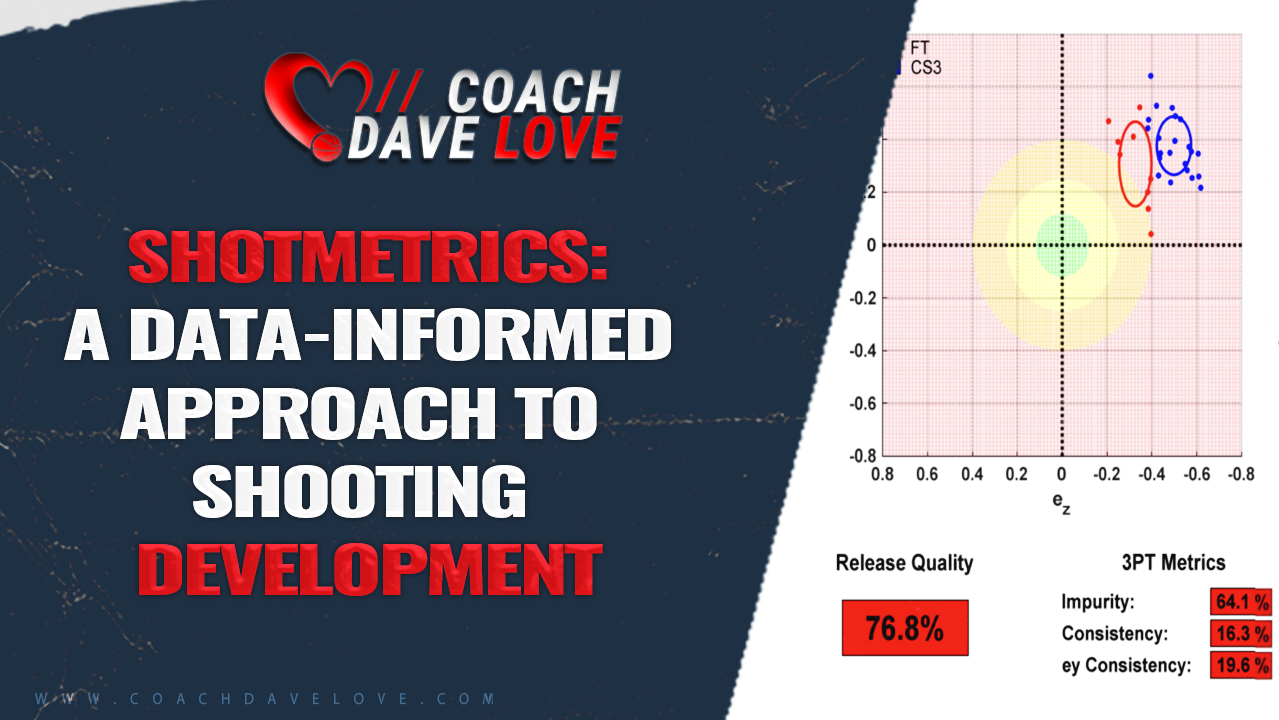
Notice that none of those are body questions yet. They're all about the flight of the ball. This is exactly the information my ShotMetrics work puts numbers on — spin axis, arc, curvature, distance control — but you can train your eye to read most of it live.
Work backwards: from the ball to the body
Once I know what the ball is doing wrong, I work backwards. The ball's behaviour narrows the search dramatically — I'm no longer scanning the whole body, I'm looking for a specific cause.
If I see a flat shot, I already know there are really only three or four ways the body tends to produce that. If the ball is spinning impurely, my research on ball spin has mapped how different body actions create different spin profiles — so I know which few things to look for instead of guessing.
And it isn't all upper body. I pay just as much attention to the lower body. Does the player get control of their body quickly after moving dynamically, or are they often a little off-balance? Are they creating Positive Energy from the ground up? Then the key question: can I tie what the lower body is doing back to their most common miss — or do I need to keep looking?
“A flat shot has only three or four likely causes. Understanding the ball movement narrows the search — so I'm looking for one of them, not hunting the whole body.”
Tweet thisDesigning the intervention
Once I understand how the body is shaping the flight of the ball, it's time to build practice that targets those areas. I don't reach for random drills. I want every task to guide the player's exploration away from the current flawed pattern and toward something more functional.
Before you change a shooter's body, read the ball. Learn the diagnostic process NBA Shooting Coach Dave Love uses to find what's really wrong with a shot.
ShareThis is where it stops being one-size-fits-all. A handful of questions change the approach completely:
- How stable is the pattern? Is this a mature player who's shot the same way for a decade, or a young player who changes their shot every two weeks?
- How much time do we have? An NBA pro with a single off-season — where not improving can mean being out of the league — is a very different job than a young player with years to develop.
- How severe is it? A below-average or streaky shooter is different from a player who struggles to make shots even in a controlled, unguarded setting.
Each of those answers pulls the plan in a different direction — often more than the diagnosis itself does.
Choosing the tool
The framework doesn't hand me a drill; it hands me a direction. From there, the tool depends on the player:
- Differential Learning. If the habit is really strong and stable, I might start here — deliberately adding variability to destabilise the old pattern before we build a new one.
- Guided Discovery. If it's a young player with years to develop, I might lean into more game-like situations and let them find a better solution over time.
- The Constraints-Led Approach. Shaping the practice environment so a more functional solution becomes the natural one to find — anywhere from lightly constrained exploration for players who mostly need to refine, to highly constrained tasks for players with deeply stable, dysfunctional movements.
- Get targeted, fast. If it's an NBA pro with one off-season and a lot on the line, I might get very specific, very quickly.
Same diagnosis, three very different plans — because the player, the timeline, and the stakes are different.
The framework
The honest answer to almost every one of these questions is “it's nuanced.” There's no flowchart that spits out the right drill. But this is the general framework I follow: find the one or two habits creating the most Negative Energy, read the ball to diagnose them, work backwards to the body, and then design practice that fits the player in front of me.
Start with the ball. It'll tell you where to look.
“When diagnosing how to improve someone's shot, start with the ball. Watch how the ball moves, then work backwards from there.”
Tweet thisReferences
- Schöllhorn, W. I. (2000). Applications of systems dynamic principles to technique and strength training. Acta Academiae Olympiquae Estoniae, 8, 67–85. (differential learning)
- Mosston, M., & Ashworth, S. (2008). Teaching Physical Education (1st online ed.). Spectrum Institute for Teaching and Learning. (guided discovery)
- Renshaw, I., Davids, K., Newcombe, D., & Roberts, W. (2019). The Constraints-Led Approach: Principles for Sports Coaching and Practice Design. Routledge. (constraints-led approach)
- Slegers, N., & Love, D. (2022). The role of ball backspin alignment and variability in basketball shooting accuracy. Journal of Sports Sciences, 40(12), 1360–1368.