Picture a music producer at a mixing board — a bank of faders, each controlling one part of the sound. Nudge one up, ease another down, and the mix changes. A great producer isn't chasing “all the way up” on every channel; they're balancing all of them to land on the right sound.
That's how I think about making a shooter's practice hard enough. There isn't one dial for difficulty. There are several — I use seven — and coaching a shot well is largely about riding those faders to keep the player exactly where the learning happens.
“Think about increasing the challenge of practice the way a producer works a mixing board — manipulating several different faders to find the right blend so that the song sounds best.”
Tweet thisThe challenge point
That “where the learning happens” has a name in the research: the challenge point (Guadagnoli & Lee, 2004). The idea is simple, but easy to get wrong. If a task is too easy, there's nothing to learn from — the player succeeds without adapting. If it's too hard, there's too much going wrong to take anything useful from it. Somewhere in between is a sweet spot: demanding enough to drive learning, not so demanding that the shot falls apart.
The goal is to spend as much of practice as possible in that challenge point. Not below it, grooving shots the player could already make in their sleep. Not miles above it, flailing. Right at the edge of what they can handle.
CDL Coaching Toolbox
The challenge-point mixer isn't just a metaphor — the Toolbox helps you set the right level of difficulty for each player and track whether it's transferring to games. Free to try.
Nominal vs. functional difficulty
Here's the distinction that makes the challenge point usable. The same researchers separate two kinds of task difficulty:
- Nominal difficulty — the built-in difficulty of the task itself, the same for everyone. A contested three off the dribble is nominally harder than an open catch-and-shoot, full stop.
- Functional difficulty — how hard the task actually is for this player, right now, given their skill and the conditions.
The challenge point is about functional difficulty. A drill that's perfectly challenging for one player is trivial for a second and overwhelming for a third — so the task has to be tuned to the individual. That's exactly what the faders are for: we adjust the nominal difficulty — the faders themselves — to find the right level of functional difficulty for that player, on that task.
The board: seven faders
When I want to change how hard a shot is, I'm really reaching for one of seven faders. Each is an independent way to add or remove difficulty:
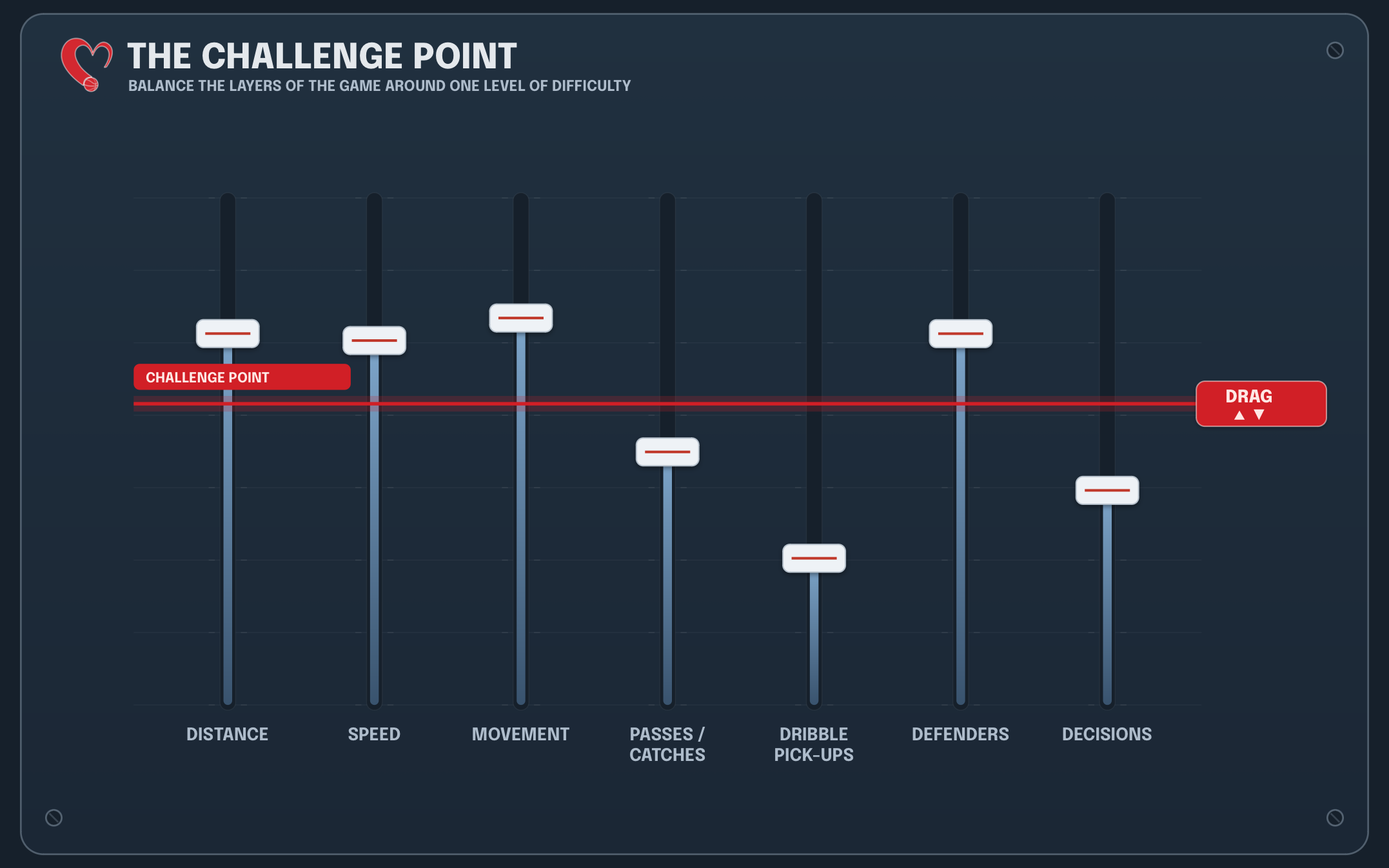
- Distance. How far from the basket the shot is taken.
- Speed. How quickly the shot goes up — the tempo of the whole action.
- Movement. Whether the player is stationary or moving into the shot.
- Passes / Catches. Catching a pass into the shot — and how varied or awkward that catch is.
- Dribble pick-ups. Gathering the ball off the dribble into the shot.
- Defenders. The presence and pressure of a defender.
- Decisions. Whether the player has to read the situation and choose — shoot, pass, or drive.
Any of these can move on its own. Nudge a couple up and the shot gets harder; ease a couple down and it gets easier. The art is choosing which to move, and by how much, to land the player in the challenge point.
Working the faders
A few rules guide how I ride the board.
Great practice keeps players right at the edge of what they can handle. Learn the seven “faders” Coach Dave Love adjusts to keep shooters in the challenge point.
ShareNever all the faders down. There should always be some challenge in the mix. A completely easy rep — stationary, open, no decision, no consequence — teaches almost nothing. Even when a player is in a fragile, early stage of building a new movement, a couple of the faders can likely sit above zero. Shots probably don't need to be from right in front of the rim, or completely stationary, or slowed to a crawl. A player might be just as functional a step inside the free-throw line, hopping into the shot, at a slow-to-moderate tempo — and if they can explore around the habit we're building at that level of difficulty, we aren't doing them any favours by reducing it.
“In the Challenge Point, we never want all the faders completely down. There should always be some challenge — that's where the learning lives.”
Tweet thisThe faders interact. When I nudge one up — say, adding a defender — I'll often ease others down for a while to keep the total challenge in the right place. Dial back the movement, shorten the distance a touch, simplify the decision. Let the player solve the new, harder problem with the rest slightly reduced — then, as they cope, gradually bring those faders back up.
“Increase the challenge of a drill in one way and you may need to ease the others down for a moment — then gradually bring them back up. That's how you keep a player in the challenge point.”
Tweet thisVary the faders to build adaptability. Constantly changing which faders are up doesn't just manage difficulty — it forces degeneracy: the player finding different functional solutions to the same task. A shot only ever practised one way is fragile. A shot practised across a shifting mix of distance, speed, movement, catches, dribble pick-ups, defenders, and decisions is one that holds up when the game throws a combination the player has never seen.
Reading the board: watch the make rate
The faders are the inputs. The make rate is the readout. If you want to know whether the board is actually set to the challenge point — not just guess — count how often the player is succeeding.
Motor-learning research puts the sweet spot around 85% success — roughly 85% makes to 15% struggle. That's enough success to keep a player engaged and confident, and enough misses to force the small adaptations that are the entire point of practising near the edge. Use it as a gauge:
- Hitting 80%+? The board's set too low — push a fader up: add movement, a defender, a decision, a step of distance.
- Down around 20%? It's set too high — ease a fader down until the player can start solving the problem again.
Then anchor it to the game. If a player is a 40% three-point shooter, a drill where they're swishing 80% isn't preparing them for anything real. Design the mix so their practice make-rate lands near their game expectation — that keeps the challenge honest, and it's what makes the practice actually transfer.
“The faders are the inputs; the make rate is the readout. If a player is hitting 80% in a drill, the board is set too low.”
Tweet thisRide the board
So don't think about difficulty as a single dial you turn up over time. Think about a board of faders — and your job as the one riding them: reading the player, keeping them at the edge, trading one challenge for another, and slowly nudging the whole mix higher. Keep them in the challenge point, and the transfer to games starts to take care of itself.
References
- Guadagnoli, M. A., & Lee, T. D. (2004). Challenge point: A framework for conceptualizing the effects of various practice conditions in motor learning. Journal of Motor Behavior, 36(2), 212–224.
- Seifert, L., Komar, J., Araújo, D., & Davids, K. (2016). Neurobiological degeneracy: A key property for functional adaptations of perception and action to constraints. Neuroscience & Biobehavioral Reviews, 69, 159–165.
- Chow, J. Y., Davids, K., Button, C., & Renshaw, I. (2016). Nonlinear Pedagogy in Skill Acquisition: An Introduction. Routledge.