The Constraints-Led Approach is having a moment. It's turning up in more gyms, more clinics, and more coaching feeds every year — and that's a good thing. But as it has spread, it's also been flattened into a caricature: “mechanics don't matter — just make it game-like and the player will figure it out.”
That's a misread of the framework — and it's exactly what makes the CLA so easy to either dismiss or misuse. This piece is here to help you make sense of it: first by being precise about what the CLA actually is, then by clearing up the misconceptions that even bought-in coaches fall into. Let's start with the foundation.
What actually makes it CLA: five boundary conditions
The CLA is a way of coaching where the player learns by exploring and solving problems inside a practice environment you've designed — not by being told the “correct” technique. Five boundary conditions have to hold for a practice to genuinely count as CLA. Inside them, what you build can look wildly different from coach to coach and player to player — they're just the floor everything else is built on.
-
The setup does the work — not your instructions
The movement should emerge from the practice you build — the space, the rules, the equipment — not from you narrating what “correct” looks like. You're allowed a view on what will work best; the rule is about delivery — you change what's around the player so the good movement becomes the natural answer. It's also why the CLA leans on an external focus of attention — the player's attention on the target and the effect of the shot, not on their own body parts.
-
The player figures it out — you don't hand it over
Self-organization is the mechanism. Your job shifts from telling the answer to building the problem. A quick verbal pointer isn't banned — the test is whether it keeps them searching, or just hands them the whole solution.
-
Make practice look like the real game
Representative learning design: what you practice has to feel and look like what the player will actually face. The information a player perceives in practice — and couples to their movement — should match what the game presents; that link is perception-action coupling. This will vary significantly from player to player, and can be scaled to the appropriate level of challenge for a player, but we don't want to entirely remove a skill from the game it is to be performed in.
-
Different players, different answers — and that's fine
Functional variability, or degeneracy: different bodies find different solutions to the same problem, and that's expected — not a mistake to fix. If you're pushing every player toward one identical “ideal” shot, you've broken this rule.
-
Every setup choice has a reason
This isn't letting players do whatever they want with no plan. Every change you make — the space, the rules, the equipment — is chosen on purpose, with a specific outcome in mind. You're just delivering that intent through the setup instead of through direct instruction.
“For practice to align with the CLA it must lean on the task to do the instruction, encourage self-organization vs prescription, maintain some degree of representativeness, allow for variable solutions, and the constraints must be purposeful.”
Click to tweetWhere it gets flattened: SSGs, defenders, and BRAD
Before the subtle misreads, look at the loud ones — the version of the CLA that actually circulates in gyms and on coaching feeds. It usually sounds like “the game teaches the game,” “just add defenders,” and a heavy lean on two things in particular: small-sided games as the one ideal drill, and cues like BRAD (“Back Rim And Down”) as the pinnacle of external feedback.
None of those is wrong. Small-sided games are genuinely valuable for the right player at the right time — an above-average shooter in a skill-adaptability phase. BRAD is a real external cue, and external cues do outperform internal ones on average. The problem is reaching for them without asking why, when, and for whom they work. Dropped on a weak shooter, a small-sided game is often too much, too soon: the constraints aren’t specific enough, the variability is too high, and the broken movement pattern never actually shifts. There is no magic in a defender or a back-rim target on its own.
It helps to remember what the CLA is actually leveraging. Players self-organize their movement around three interacting constraints: task (distance, ball size, the rules of the drill), environment (defenders, time pressure, the gym), and the individual (height, strength, and the habits they walk in with). The coach’s job is to shape those constraints so a better solution becomes the natural answer — which means you have to know what you’re guiding the player toward. Without that intent, a small-sided game is just as limited as a blocked, prescriptive drill. It’s the same mistake at the opposite end of the continuum: activity without a target.
That tactical misuse is the visible symptom. Underneath it, each of the five conditions is easy to flatten in a subtler way — and three of those misreads do the most damage: treating perception-action coupling as if it were purely visual, treating representativeness as one-size-fits-all, and treating an external focus of attention as an unbreakable law rather than a strong general rule. Those are the misconceptions worth clearing up — and they're where even bought-in coaches, and the popular version of the CLA, tend to go wrong.
To pressure-test each one, I reached out to Dr. Sam Jermyn, Lecturer in Skill Acquisition at Munster Technological University — the same institution where I am completing my Master's — and Skill Acquisition Specialist for the Ireland Senior Women's Basketball programme. Sam's work sits at the intersection of ecological dynamics and applied sport science, and he is one of the sharper thinkers I know on the gap between what the theory says and what coaches actually need to do. Over several conversations, we worked through what perception-action coupling actually means, what the empirical evidence does and does not support, and why the weakest shooters may require an approach that challenges some of the dominant CLA narratives.
What follows draws directly from those conversations. I've been coaching shooting at the NBA level for 15+ years — with the Phoenix Suns, Dallas Mavericks, Cleveland Cavaliers, and Orlando Magic — and I'm currently completing my Master's in Skill Acquisition in Sport. Some of what Sam said challenged my thinking. Some of it confirmed instincts I'd been talked out of. All of it, I think, matters for how you coach.
Perception-action coupling is not just visual
Let's start with the term that gets misused more than any other in ecological coaching discourse: perception-action coupling.
When a lot of coaches hear this phrase — especially in a CLA context — they might picture something very specific: a player reading the defense, picking up visual information from the environment, and coupling that to a shooting action. Game speed, game context, defenders closing out. That's the mental image, and it leads to a predictable prescription: make practice look like a game.
But that framing collapses the richness of what perception-action coupling actually describes. As Sam put it:
"We have multiple different perceptual systems. We are always coupling the information that we obtain from those perceptual systems to any form of action. By means of coaching, by means of practice design, we can regulate to some extent the system that we are using within that perceptual-action loop — which system we're relying on most within any one moment in time."
This matters enormously for shooting development. Proprioception is a perceptual system. Haptic information is a perceptual system. When a coach works with a player on movement coordination — on the feel of the set position, the kinesthetic awareness of elbow angle, the sensation of hand placement — that player is still coupling perceptual information to action. The coupling hasn't disappeared. The system being relied upon has shifted.
“There are various forms of perception-action coupling, and perceiving the opportunity to shoot is just one. Other valuable forms in shooting include perceiving what happens to the ball after a new movement, or perceiving the feeling of a new movement.”
Click to tweetSam was direct about how this gets misread in applied settings:
"If someone is saying that you're not preserving perception-action coupling (because there isn't a defender present in a drill) — it's not that you're not preserving perception-action coupling. Perception-action coupling is absolutely intact there. It's just reliance on a different perceptual system beyond the visual system. And the relationship between that system and the way it's being used in that moment relative to the action it's regulating may not necessarily be all that representative of what's actually encountered in competition. That's not to say that it's not valuable. That's not to say that it doesn't serve a purpose."
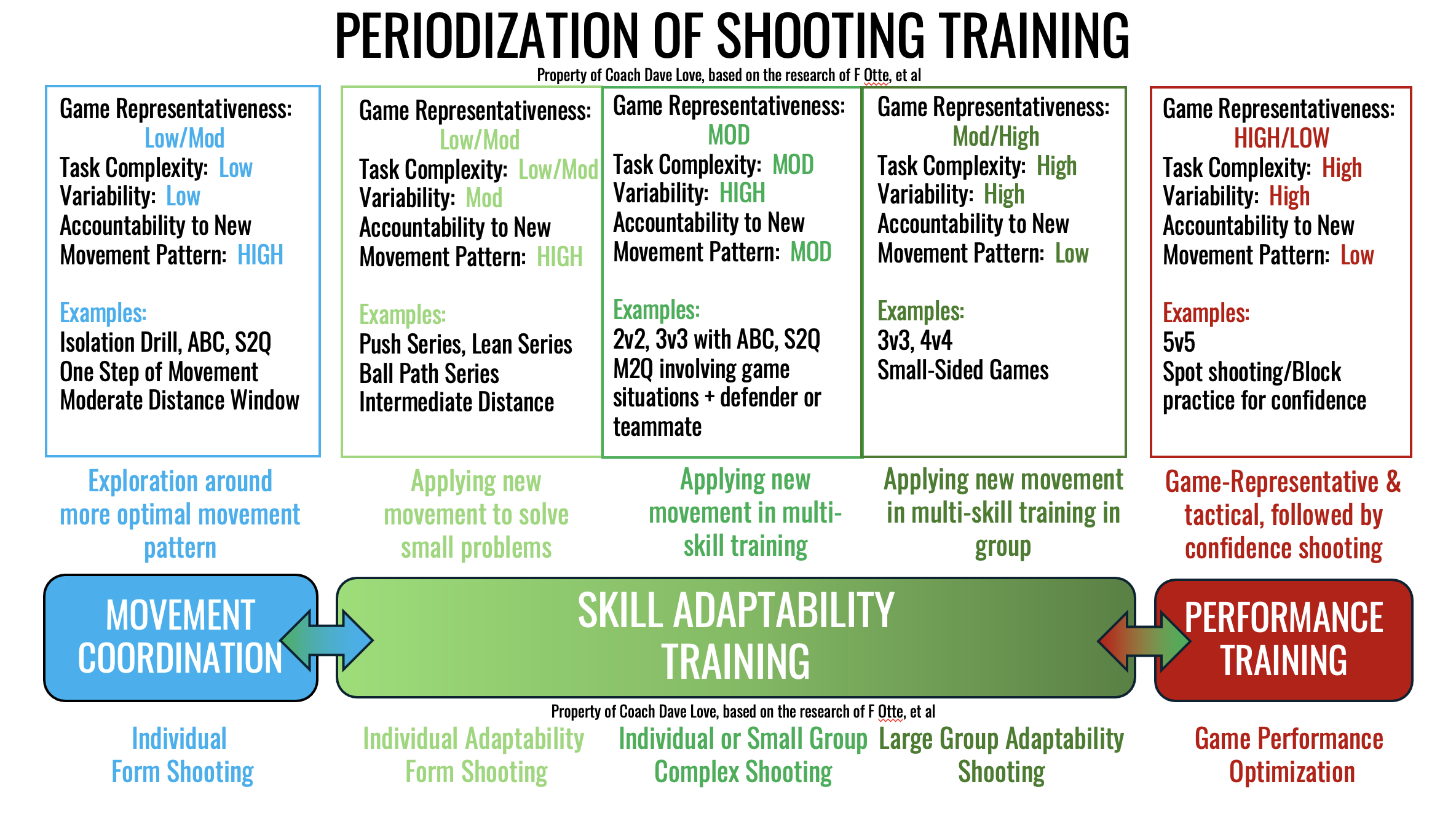
From my own coaching perspective, this validated something I'd been wrestling with. The argument I make in my research is that external perception-action coupling is absolutely the primary focus for the average or better shooter — players with functional movement patterns who are spending their time in the skill-adaptability phases. For those players, game-like practice, high variability, and externally-coupled tasks are exactly right.
But for the small subset of players I've been calling dysfunctional shooters — players with deeply stable, entrenched movement patterns that aren't serving them — that argument gets complicated in ways the popular CLA narrative doesn't fully address.
The evidence on external focus is real — and incomplete
The second area where the popular CLA narrative oversimplifies involves focus of attention research. The empirical record is actually clear: across a wide range of motor tasks and populations, an external focus of attention produces better performance, learning, and transfer than an internal focus. This is well-replicated work, and coaches who cite it are citing something real.
But "well-replicated across groups" is not the same as "applicable to every individual in every context." Sam raised this distinction carefully:
"A lot of the time we hear people hanging their hat on the value of an external focus of attention from a performance point of view, from a learning point of view. And those findings are pretty robust. But one of the critiques that we can make about some of the empirical work is that the findings are focused on between-group differences. It brings up the question: maybe within a certain cohort, there are some individuals who benefit from an internal focus of attention. We don't know."
This is not a fringe position. It's an honest reading of what the research can and cannot tell us. Group-level findings establish a general principle; they don't tell you that every player in your gym will respond the same way. And for shooting development — where you may be working with a player whose proprioceptive system is profoundly dysregulated and has been for years — the assumption that external focus always dominates deserves scrutiny.
“An external focus of attention is likely the desired end point for most shooters, but that doesn't mean it is the starting point for all shooters. There may also be value in small or targeted doses of internal focus of attention.”
Click to tweetThat scrutiny exists within the published literature itself. Toner and Moran, writing in Psychology of Sport and Exercise in 2015, argued that a degree of conscious bodily attention — what they termed "somaesthetic awareness" — may actually be valuable for skilled performers who are actively trying to detect and correct inefficient movement patterns during deliberate practice. The debate between that position and the dominant external focus literature remains live, which itself says something worth sitting with: the science hasn't settled this question as cleanly as the simplified version of CLA tends to suggest.
CDL Coaching Toolbox
Diagnose the shot in front of you, design practice with intent, and track whether a change is actually holding — the tools behind this kind of coaching. Free to try.
Sam went further, noting that even when technical work is being done in what looks like an "internal" mode, the task design question remains live:
"While we can rationalize and justify a part-practice approach — I want to focus in on this aspect of the skill — can I still go about it in a way that facilitates more of an external focus of attention? So that's where your task design comes in. Even though I am doing something that isn't the full jump shot, there still may be consequence, there still may be variability. But it's still part of the skill, not the full movement itself."
This is a more sophisticated position than the binary the social media version offers. The question isn't "external or internal?" as if those are fixed practice categories. It's: given what I'm trying to accomplish with this player at this stage, what perceptual system is most useful to engage, and how do I design the task accordingly — even if the task itself is technically oriented?
The BRAD cue is a good case study in exactly this. “Back Rim And Down” is a clean external cue, and that is a point in its favor. But it points a player at an outcome, not a movement, and it carries no constraint — two shooters can chase a back-rim make with wildly different mechanics, one of them the very pattern you are trying to change. Tell a player who misses because their feet are too close together and their base is unstable to “get a BRAD,” and nothing about the cue makes the change you actually need. BRAD can support a cueing system. For a player who has to rebuild the movement itself, it is not enough on its own.
The weak shooter lives in a different representative environment
Here is the argument at the heart of what I've been calling the Weak Shooter Paradox, and it's the one I think most CLA-oriented coaches haven't fully reckoned with.
The standard ecological argument for representative practice goes like this: practice should reflect the information-action coupling of competition. Make the practice context look as much like the game context as possible by adding a defender. This argument makes perfect sense for the average or better shooter — a player with a functional movement pattern who just needs to become more adaptable under varying conditions. That player should absolutely be spending the bulk of their time in high-variability, game-representative environments, and their representative environment involves defenders.
But what about the player who cannot shoot? The player who has, through years of deeply ingrained patterning, developed a movement solution so dysfunctional and so stable that even the game environment provides no corrective pressure? The CLA argument assumes that competition guides players to explore more functional movement patterns. For these shooters, it doesn't. Defenders — which might not exist in their representative environment — only perturb the shooter further away from functional solutions, and the absence of defenders allows the current dysfunctional movement to continue to exist.
As I laid it out to Sam:
"There is a small subset of players who do not have a functional movement pattern, who have a very stable dysfunctional movement pattern and need to be spending much more time in a movement coordination phase. And while a movement coordination phase can still and probably should still have some degrees of external perception-action coupling and hopefully is moving towards a more external focus of attention, that doesn't mean that we necessarily start there with these super stable, super dysfunctional players."
The other wrinkle is representativeness itself. Consider a player who is only asked to shoot free throws because their team doesn't trust them to shoot anything else — whose team, frankly, wishes they could opt out of even that:
"In their representative environment, there is no external, or very little external, perception-action coupling, at least in the same way that there is for Steph Curry."
The representative environment for this player is not the same as the representative environment for a functional shooter. If your argument for game-like practice is that it reflects what actually happens in competition, then you need to be honest about what actually happens in competition for this player. And what happens is very little externally-coupled shooting — a much more constrained, proprioceptively demanding situation. Designing practice to reflect that reality isn't a CLA violation. It's CLA applied correctly.
“The CLA calls for representative practice, but coaches need to understand there are different representative environments for different levels of shooters. The best shooter in the game may face 3 defenders while a weak shooter's environment might be unguarded and stationary.”
Click to tweetThat also means you can't dismiss proprioceptive perception-action coupling as unimportant simply because it isn't visual. As I put it to Sam: "It's not fair to say that there is no perception-action coupling just because there is no external perception-action coupling. There is — it's just more proprioceptive or haptic in nature. And proprioceptive perception-action coupling can't be dismissed as unimportant for a player whose proprioception is completely off and stable in a dysfunctional way."
Sam didn't push back on that framing. He added only that the practical question — what does the coaching and task design look like around that technical work — remains worth pressing on, because even within a part-practice or movement coordination context, there are still questions about how far toward an external or internal orientation the work can and should lean.
What to do instead: contemporary form shooting
So what does the work look like for that weak shooter, if not a small-sided game? This is where a distinction matters that the caricature erases — between two very different things that both get called “form shooting.”
- Traditional form shooting is highly decomposed, repetitive, and stationary — the youth-practice warmup where a player takes the same close, unopposed shot on a loop. It isolates too much and transfers poorly, and it is not CLA-aligned.
- Contemporary form shooting — what I would call Movement Coordination Training — is purposeful practice that reduces complexity without eliminating variability or intent. Used wisely, for a re-patterning shooter, it is entirely consistent with the CLA.
Movement Coordination Training
Contemporary form shooting — purposeful practice to explore, attune to, and stabilize a new movement solution.
Purpose
- Determine a specific intention for the player to explore around.
- Help the player attune to the differences between motor solutions.
- Stabilize movement solutions in low-variability environments.
Drills
- Contemporary movement-coordination activities
- Differential Learning
- Guided Discovery
Variability
- Change the spot on nearly every shot.
- Vary the distance within an appropriate window.
- Add one step of movement once the new pattern emerges.
- Layer in a soft-toss catch on the move, when it fits.
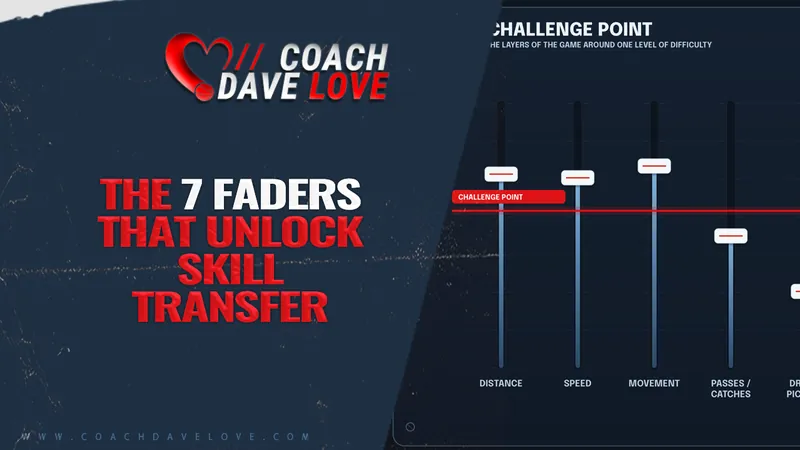
The move that makes the difference is lowering the nominal difficulty — the stuff that is hard for everyone, like a live defender or a deep, moving three — so you can find the functional difficulty, the thing that is actually hard for this player. You are not reverting to blocked, mindless reps. You are manipulating variability, complexity, and constraints until the player is working right at their Challenge Point, where learning is maximized. Simplified complexity, not mindless reps. Reduced representativeness, not total isolation. Layered variability, not chaos.
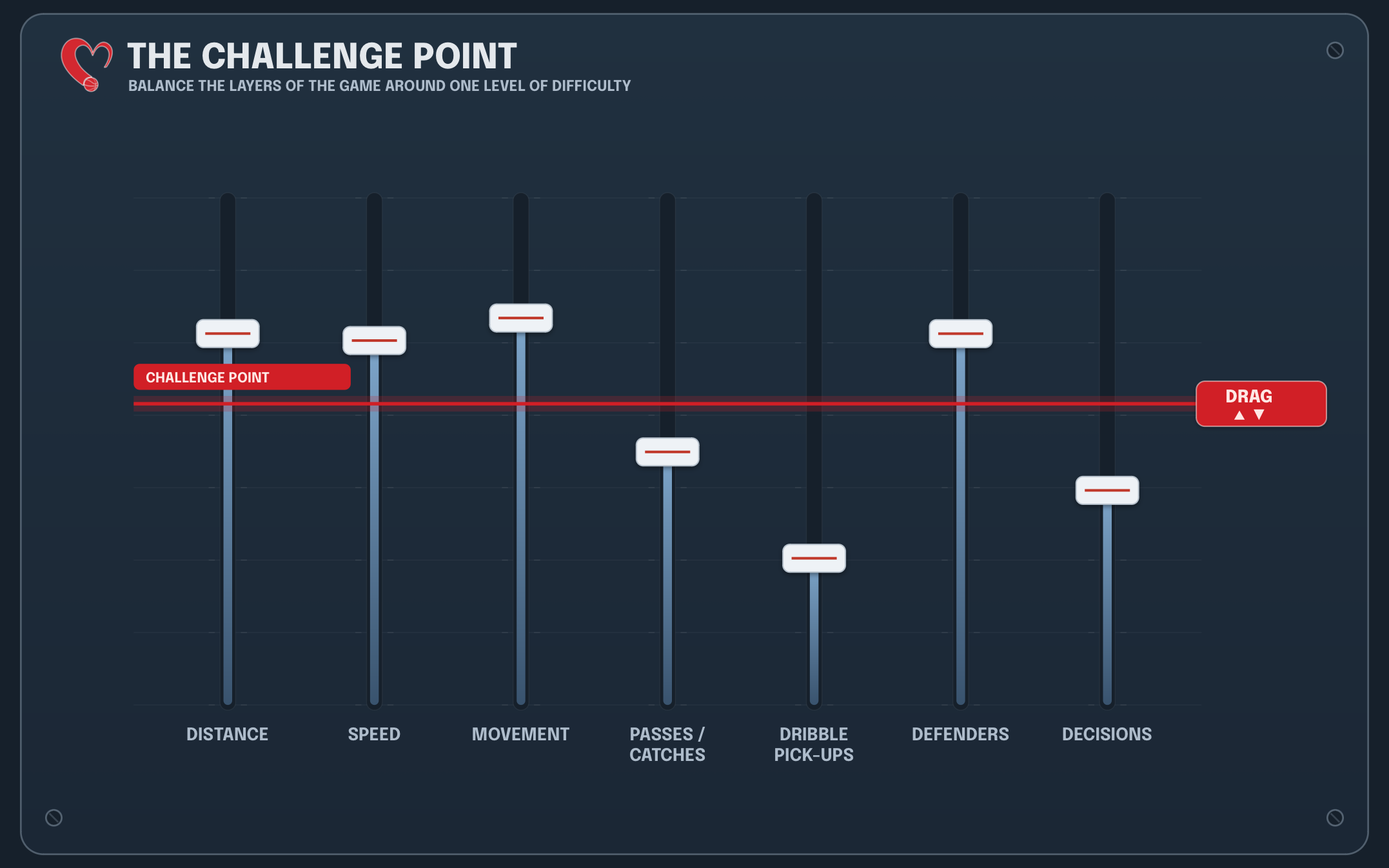
“Don’t oversimplify to the point of losing meaning. Don’t overcomplicate to the point of paralyzing the player.”
Click to tweetDone this way, simplifying a skill to explore a new pattern is not a retreat from the CLA. It is how you honor it for a player the game has stopped teaching — reduce what is in the way, keep just enough consequence and variability to make the practice real, and rebuild the movement so it can eventually hold up in chaos again.
The risk of leading with the theory
Sam's observation about what happens when coaches let ecological theory set the boundaries of their practice touched on something I think about a lot in my own work.
As I've gone deeper into ecological dynamics, I've found myself periodically questioning whether certain tools I've used effectively — tools that produced real results with dysfunctional shooters — fit cleanly within the framework. The more useful question, I've come to believe, is not whether a tool is ecological enough, but whether I can apply it in a way that moves toward more ecological principles over time. The goal isn't to discard what works; it's to understand why it works, refine how it's used, and select it because it's the best option for that player in that moment — not because it satisfies a theoretical checklist.
The Constraints-Led Approach is powerful — and badly misunderstood. Learn how Coach Dave Love actually applies the CLA to shooting, without the dogma.
ShareThat orientation aligns closely with something my mentor Dr. Ed Coughlan — one of the architects of the MTU MSc programme and a leading voice in applied skill acquisition — has said directly: "Your job is not to exclusively coach to one theory. Your job is to understand a variety of theories and select the best form of practice for the player in that moment."
That's the standard. And it's one the dominant CLA narrative, as it tends to circulate online, doesn't always meet.
“It is important for coaches to understand the CLA and use it when it's the best tool available for the task at hand. But high-level coaches should be wary of limiting themselves to a single tool when other viable options are available and players' careers are at stake.”
Click to tweetSam named the pattern directly. The danger, as he sees it, is not the ecological approach going mainstream — it is coaches pushing it hard without deeply understanding its limits, or how much it actually shares with the cognitive tradition it is so often set against. The result is a kind of paralysis by dogma:
"We get these very black-and-white, boxed-in understandings of what ecological dynamics is. And it leads to this whole thing of 'I can only do this type of practice in order for it to be ecological.' So it's very much: I'm going to solve the problem of enacting the theory — and those are my bounds in regards to what I can do — as opposed to starting with the problem in front of me, the athlete I'm working with, and then working backwards from there."
The theory becomes the starting point rather than the scaffold. As Sam put it, the more productive sequence runs in the other direction: start with the athlete, the problem, and the context — then reach for the framework that best serves all three.
The evidence base is deeper than one framework
One more point Sam raised deserves attention, particularly for coaches who have been told that CLA "has the evidence" on its side.
It does have evidence. Real evidence. But the intellectual honesty that serious ecological dynamics researchers bring to this field — people like Keith Davids, who is central to ecological dynamics as a whole — includes acknowledging gaps in what they've said and haven't said, and acknowledging that the evidence base for cognitive and representational approaches to skill acquisition is vastly deeper and older. Sam was direct about this:
"The breadth and depth of the empirical work and the evidence that is there for ecological approaches, and there for more cognitive approaches — we almost can't really compare them, because there's decades and decades of really strong, robust work that has been done from a cognitive or representational point of view, and maybe not to the same extent with an ecological point of view."
This isn’t a case against ecological approaches. It’s a case for holding them with appropriate humility — a serious, growing body of work that sits alongside, not on top of, decades of robust cognitive and representational research. There is even a quiet irony worth naming: CLA advocates sometimes defend the approach by pointing to benefits like implicit learning — research with deep roots in the cognitive tradition. (Rich Masters’ influential 1992 work, showing that skills learned without explicit, verbalizable rules hold up better under pressure, sits squarely in that camp.) Leaning on it is not wrong, but it should make us humble about the boundaries we draw. The athletes, after all, do not know which theoretical camp their coach belongs to.
“The CLA is often touted as an evidence-based approach. And while this is true, coaches need to remember there are other approaches also supported by evidence, and that past success with any method is also valid evidence.”
Click to tweetWhat this means for your coaching
None of this is an argument against ecological dynamics or the Constraints-Led Approach. Used with genuine understanding of its scope and its limits, it's a powerful framework — for the right players, at the right phase, in the right context.
But it is an argument for something more important than any framework: starting with the player, not the theory.
For most of the shooters you work with — players with functional movement patterns who need to become more adaptable, more consistent under pressure, more capable in game chaos — an ecological orientation, with high variability, representative tasks, and external perception-action coupling as the primary driver, is exactly right. That's where they should spend most of their time.
For the smaller group of deeply dysfunctional shooters — players whose movement patterns are so entrenched that the game has never exerted meaningful corrective pressure — a different path may be needed. One that is willing to:
- Work in a movement coordination phase longer than a strict ecological reading might suggest
- Engage proprioceptive and haptic perception-action coupling as legitimate and valuable, not as a compromise
- Recognize that their representative environment genuinely differs from a functional shooter's
- Ask what focus of attention actually serves this individual, not what the group-level data predicts
- Design tasks that target specific movement elements while still incorporating consequence and variability where possible
- Work backwards from the athlete to the theory, rather than forwards from the theory to the athlete
And notice this cuts both ways. The old mistake was decades of isolated, blocked drills and linear models of learning; the CLA is a powerful correction to it. But the fix for over-prescription is not the opposite extreme of “just add defenders and hope.” Form shooting has a place when it is contemporary and purposeful, unopposed practice has a place when it is carefully constrained, and intentional feedback has a place when it is framed as exploration. Adding defenders is a superb way to drive tactical exploration — reads, spacing, timing under pressure — but it is not always the way to change a motor pattern, and for a deeply grooved one it often reinforces the very habit you are trying to break.
“The best coaches aren’t minimalists or maximalists. They’re architects.”
Click to tweetThat, ultimately, is what good ecological coaching actually requires. Not a checklist. Not a set of prescribed bounds. A commitment to understanding the player in front of you deeply enough to know which tools — from any tradition — will best serve their development.
The goal was never to be all-in on the CLA. It was always to use the CLA when the CLA is the best tool for the job. That distinction is small in theory and enormous in practice — and it's the one worth defending.
References
- Masters, R. S. W. (1992). Knowledge, knerves and know-how: The role of explicit versus implicit knowledge in the breakdown of a complex motor skill under pressure. British Journal of Psychology, 83(3), 343–358.
- Toner, J., & Moran, A. (2015). Enhancing performance proficiency at the expert level: Considering the role of ‘somaesthetic awareness.’ Psychology of Sport and Exercise, 16, 110–117.
- Davids, K., Button, C., & Bennett, S. J. (2008). Dynamics of skill acquisition: A constraints-led approach. Human Kinetics.