Here's a mistake I see constantly — from players, and from plenty of coaches too. A shooter works hard on a new habit in a simple, controlled setting: no defender, no clock, no decision. They get it looking clean. And then they expect that habit to simply show up in a game — fully formed, under pressure, against a closeout. It almost never does.
It's like standing on one bank of a river, looking at the far side, and expecting to clear it in a single jump. The river is just too wide. What's missing is a bridge — and in shooting development, that bridge has a name.
Where the mistake comes from
This belief — perfect the movement in isolation, and it will transfer on its own — comes from an outdated way of thinking about how skills are built. It's rooted in the old Information Processing view: that a skill is a fixed motor program you groove in a quiet room and then run wherever you like. Nail the program, the thinking goes, and the rest takes care of itself.
But skill doesn't work that way. In a game, action is continuously coupled to perception — the shot is regulated moment to moment by what the player sees and feels: the flight of the pass, the closing defender, their own balance sliding out from under them. This perception–action coupling is exactly what a sterile drill strips away. Take out the game's information and there's nothing for the movement to couple to — so a habit that looks perfect in a quiet gym is a habit that only lives on one side of the river.
The Periodization Workbook
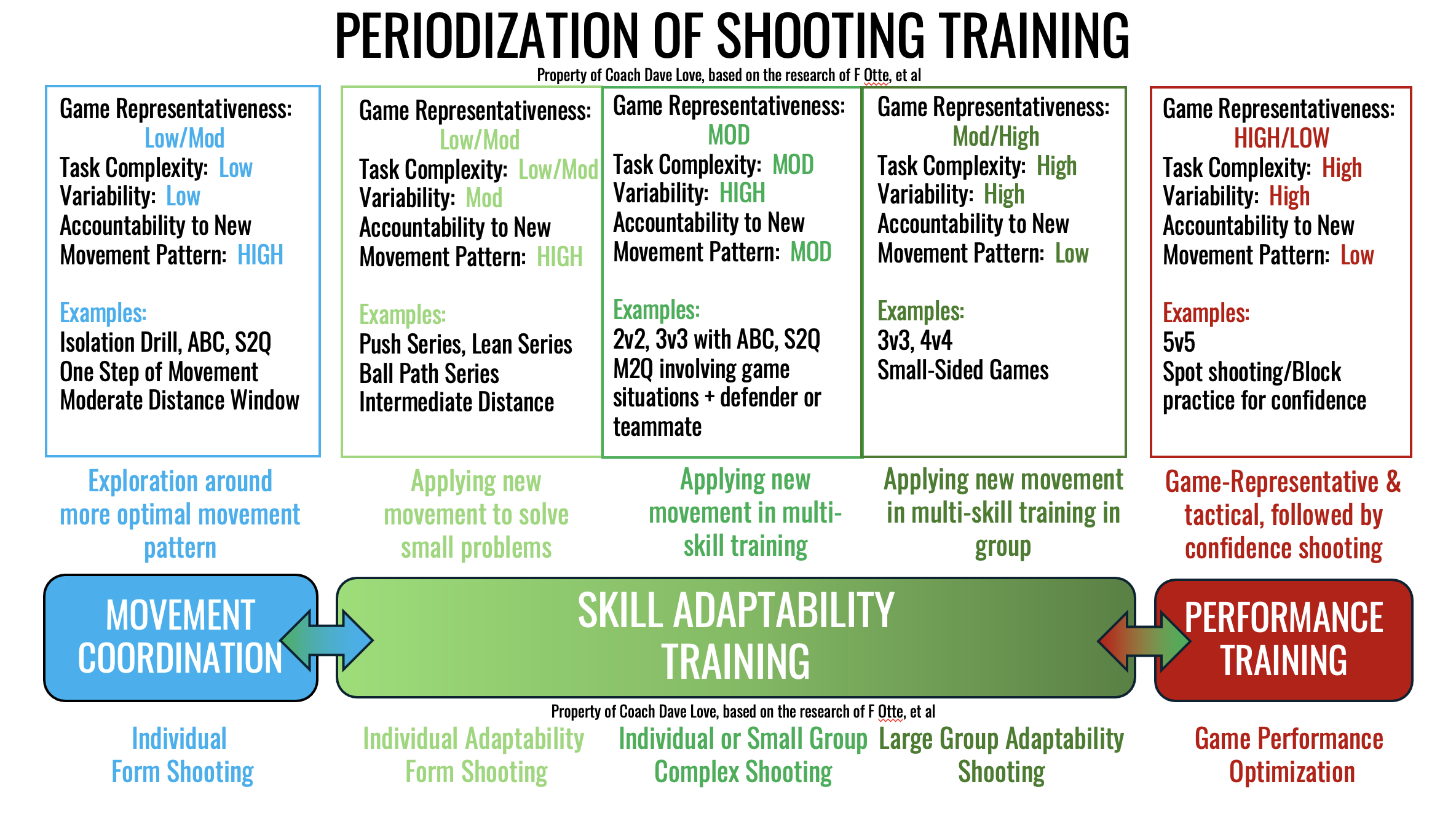
Skill Adaptability is one phase of the PoST framework. The workbook helps you map Movement Coordination, Skill Adaptability, and the rest across a season.
“You can't perfect a habit in a quiet gym and expect it to survive a game. The gap between them has to be trained — that's the bridge.”
Tweet thisA shot is one skill in a sequence
There's a deeper reason a perfect drill habit doesn't survive a game. A shot is never performed on its own. In a game it's a discrete skill buried in a sequence of other skills — a player sprints, cuts, catches a pass that's a little off, gathers off the wrong foot, and then shoots. The shot is the last link in a chain, and the links before it change on every possession. The game won't let the shot be fired off the clean, quick way it was grooved in the gym.
And here's the catch: every skill in that chain has its own best way of solving its own problem — and those solutions don't line up with each other. The optimal way to handle the skill before the shot is often exactly the wrong way to set up the shot itself.
Take catching a bad pass. On its own, the safest way to secure a ball coming in hot is to get both hands firmly on opposite sides of it. Great catch — terrible start to a shot, because now the shooting hand is on the side of the ball instead of under it, and the player has to fix that before they can rise. In a game those two problems arrive together, a tenth of a second apart, and the player has to reconcile them on the fly.
Or take posture. The body position that keeps a player stable coming out of a hard cut or an awkward landing isn't necessarily the position that lets them generate power into the shot. In a drill you'd never have to solve both at once. In a game, you solve them in the same motion.
“The safest way to catch a bad pass is a terrible way to start a shot. In a game, those two problems arrive together — and the player has to solve them at once.”
Tweet thisThis is exactly what practicing in isolation can't teach. A shot rehearsed by itself — perfect feed, balanced base, every rep — is never exposed to the degeneracy the game demands: the many slightly different ways the same shot has to be solved when the skills around it keep changing. And because the shot is coupled to what the player perceives in the moment, a rep with a perfect feed and no defender is a rep missing the very information the shot is supposed to adapt to. Groove only the perfect solution, and you've built a shot that only works when everything before it is perfect too. The game is never that tidy.
The bridge: Skill Adaptability
In the PoST framework, the phase where a player first builds a new, more functional movement is Movement Coordination (MCT). That's the stabilising work — grooving the new pattern until it holds together. But stabilising a movement in a simple setting is only half the job. The other half is learning to adapt it. That's Skill Adaptability.
Skill Adaptability is the bridge, and Skill Adaptability Training (SAT) is how you build it. SAT takes the new movement pattern and starts adding the complexity and representativeness a real game brings — in the same ways a game brings it — so the player gradually learns to adapt the pattern rather than hoping it survives untouched.
Early on, SAT can be as simple as a challenge that forces a little degeneracy around the new pattern — small, functional variations on the same movement. From there it builds: more defenders, more teammates, more of everything a game actually asks of a shot.
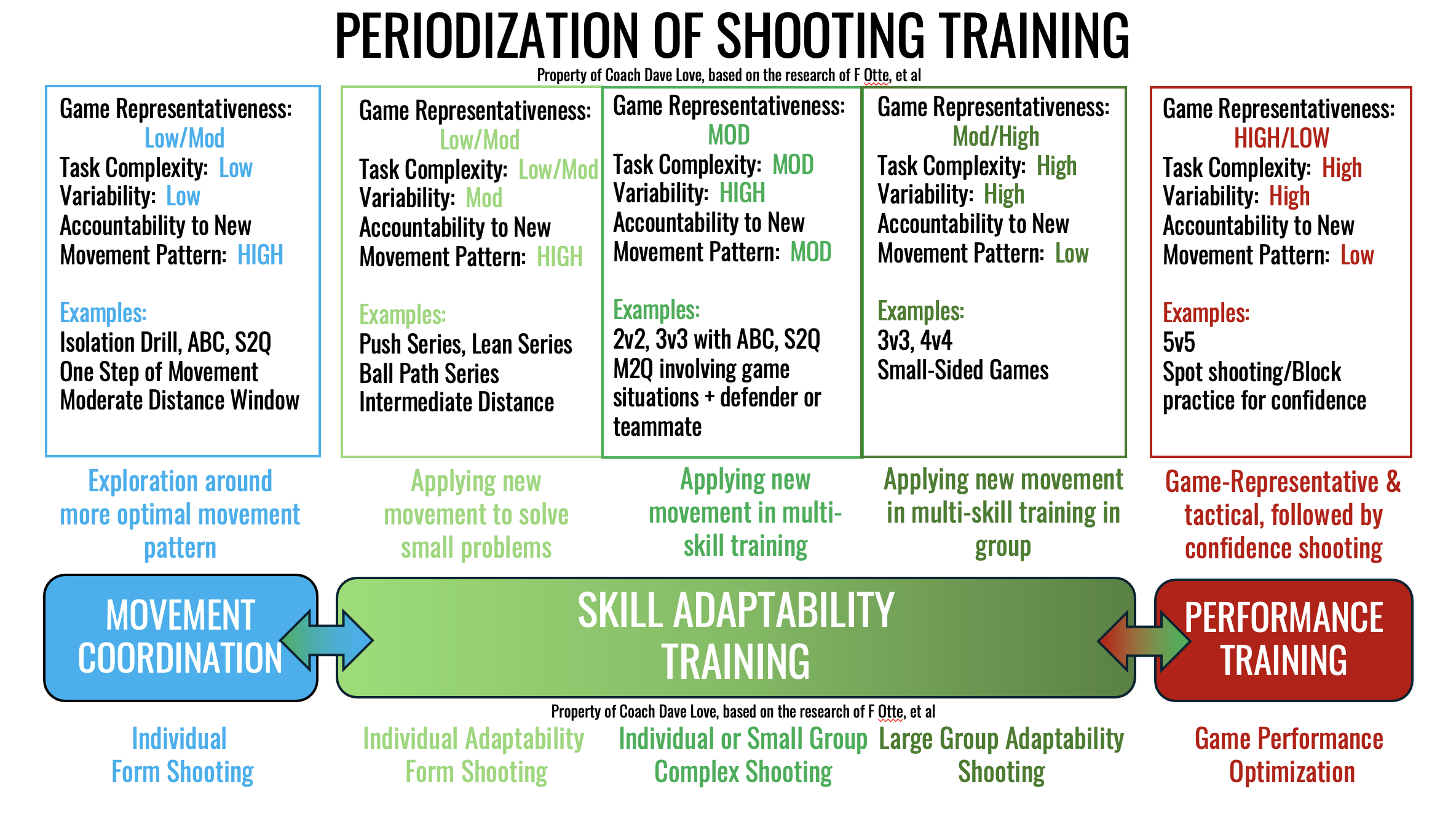
The three sub-phases of SAT
SAT isn't one thing; it progresses through three sub-phases, each adding more of what makes a game hard — more teammates and defenders, more uncertainty, and a greater variety of changes to react to. Here's how I actually run them:
Stabilizing a new shot in an empty gym is only a small part of the job. Learn how Coach Dave Love bridges the gap from a stable, effective shooting motion to a game-ready skill.
Share- SAT-MV — Movement Variation. The first layer: individual adaptability form shooting. This is where the player starts connecting the shot to the skills around it — catching a ball placed a little off, shooting out of a slightly compromised base, adjusting the feet — folding those small, game-like problems into the new pattern without losing it. Balance work like a Push Series or a Lean Series lives here too. High accountability to the new movement, small functional variations around it.
- SAT-CT — Complex Training. Next: individual or small-group complex shooting. This is where teammates and defenders ramp up — the new movement gets applied inside real game situations, against a defender or with a teammate — 2v2, 3v3, live reads. Representativeness and variability climb, while the accountability to the new pattern eases as the player learns to hold it together under complexity.
- SAT-TBT — Team-Based Training. Finally: large-group adaptability shooting. More teammates and defenders still — it scales up to 3v3, 4v4, and small-sided games, closer to the full chaos, variety, and uncertainty of a real game, where the movement has to hold up on its own.
Each step keeps the new movement intact while asking the player to bend it to a harder, less predictable problem — exactly what the game will demand.
Learning isn't linear
One important caveat: none of this is a straight line. Learning is non-linear, and these phases aren't strict stages you graduate from one at a time.
Even a mature player spending most of their time in Movement Coordination — because they're rebuilding a genuinely new, more functional pattern — should still be doing some SAT. Just in smaller doses, with the complexity scaled to where they actually are. Because stabilising the new movement (the job of MCT) and learning to stretch and adapt it (the job of SAT) are equally important. Neglect the second, and you've built a habit that can't cross the river.
“Stabilising a new movement is only half the job of becoming skilled. Learning to adapt it is the other half.”
Tweet thisBuild the bridge
If a player is working on something new, don't wait until it's “perfect” to introduce complexity — and don't expect a clean drill to magically become a clean game shot. Build the bridge as you go: stabilise the movement, then progressively ask it to adapt — defender by defender, decision by decision — until the far bank isn't a leap away. It's a walk across.
“The river between a new skill and applying into games is too wide to clear in one jump. Skill Adaptability is the bridge across it.”
Tweet thisReferences
- Otte, F. W., Millar, S.-K., & Klatt, S. (2019). Skill training periodization in “specialist” sports coaching—An introduction of the “PoST” framework for skill development. Frontiers in Sports and Active Living, 1, 61.
- Love, D., Otte, F., & Davids, K. (2025). Skill adaptation in basketball coaching: Harnessing periodization and individualization in scheduling NBA shooting practice. International Journal of Sports Science & Coaching, 20(5), 2170–2184.
- Pinder, R. A., Davids, K., Renshaw, I., & Araújo, D. (2011). Representative learning design and functionality of research and practice in sport. Journal of Sport and Exercise Psychology, 33(1), 146–155.
- Chow, J. Y., Davids, K., Button, C., & Renshaw, I. (2016). Nonlinear Pedagogy in Skill Acquisition: An Introduction. Routledge.
- Seifert, L., Komar, J., Araújo, D., & Davids, K. (2016). Neurobiological degeneracy: A key property for functional adaptations of perception and action to constraints. Neuroscience & Biobehavioral Reviews, 69, 159–165.