For decades, coaches have chased "muscle memory." The logic feels airtight: repeat a motion enough times and it etches itself into the body, ready to be recalled under pressure. Just get up your reps and the shot becomes automatic.
There is one problem. Muscles do not have memory.
What actually improves with practice is your nervous system learning to coordinate movement against sensory information and past experience. That learning was never about locking in one exact pattern. It is about tuning your responses to the constantly shifting demands of the game. So the goal is not to memorize one shot. It is to learn to adapt your shot, and adaptability is the part most people mistake for something that gets in the way of skill.
With this in mind, players and coaches should be leaning into the very thing they have historically worked to reduce: variability.
“Great shooting is not about memorizing one shot. It’s about learning to adapt your shot.”
Tweet thisThe game never repeats itself
Watch a great shooter closely and you will not see one shot executed a thousand identical times. You will see a thousand slightly different shots, each one solved on the spot for a different pass angle, a different foot position, a defender who is a half-step closer, a body that is a little more tired in the fourth quarter. None of those shots is a copy. Every one is an adaptation.
This is the whole idea behind the Sandbox: there is no single perfect form waiting to be found, because there are many different movements that all get the job done. A skilled shooter is not repeating one solution. They are roaming the whole landscape of solutions and picking the one that fits the moment. Skill acquisition has a word for that. Many different movement paths reaching the same outcome is called degeneracy, and it is a feature, not a flaw.
Repetition without repetition
The scientist who saw this first was Nikolai Bernstein, the Russian physiologist we met in How People Actually Learn Skills. He studied expert blacksmiths and found something strange: the path of the hammer head was more consistent than the path of any single joint in the arm. The parts moved differently every swing. The outcome stayed the same. He called great practice "repetition without repetition," and it reframes what we are really building.
“Practice is a particular type of repetition without repetition.”
Two ideas fall out of this. The first is degrees of freedom, all the independently moving parts a shooter has to coordinate. A beginner, overwhelmed, tends to freeze them, locking joints to make the problem simpler. As they get skilled, they free those joints and start using them, and that freedom is where adaptability comes from. The second is the most important, most misunderstood point in this whole topic: great shooters are not less variable. They are variable in the right places. Their joints, their timing, their gather can all vary quite a bit from shot to shot, precisely so that the ball does not have to. When the release runs a touch early, something downstream quietly compensates. What looks like a machine repeating itself is actually a system absorbing variation so the outcome holds steady.
“What looks like consistency in a great shooter is actually stability through variability.”
Tweet thisYou can see it in his own data. Line up twenty of Stephen Curry's made threes from behind, aligned at the moment of release, and the ball arrives from all over: different gathers, different paths into his hands. Then everything funnels into the same narrow release window.
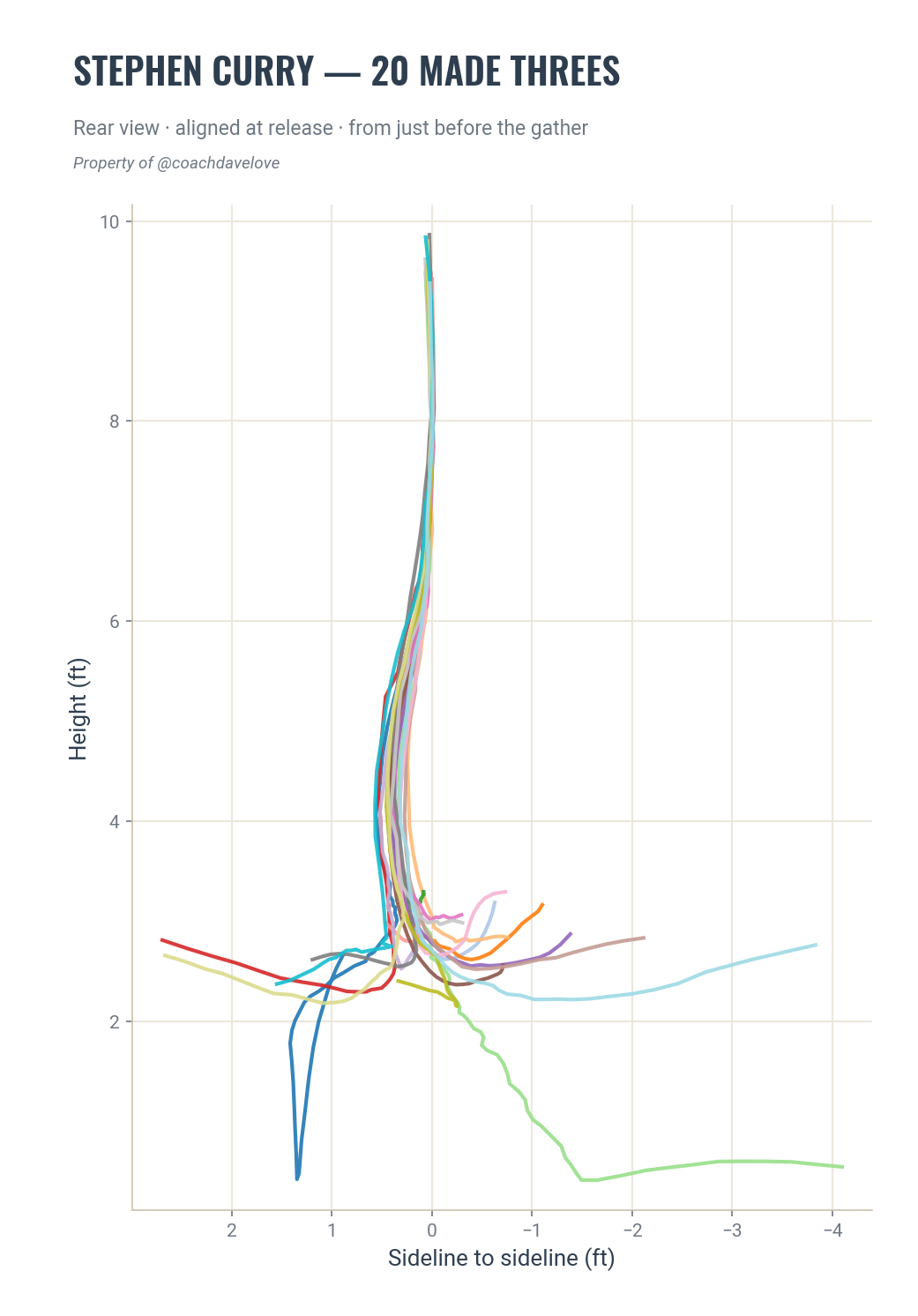
That is degeneracy and stability through variability in one picture. And it is why variability does not mean chaos. Random flailing is not skill. Coordinated variability that protects the outcome is.
Even the "identical" free throw is not identical
A coach once pushed back on me: free throws are the one shot that is the same every time, so why would I add variability to free-throw practice? It is a fair question, and the answer surprised him.
Start with the things we cannot easily measure: how early it is in the game, how fresh the legs are, a minor injury, the anxiety of the moment. Then add the ones we can. Air temperature, humidity, altitude, and even the weight of the ball, which grows heavier as it soaks up sweat and humidity, all change how far a shot travels. Denser cold air drags the ball down sooner. Thin Denver air lets it sail. I once ran the numbers on two gyms at the extremes, a cold humid arena at sea level and a hot dry gym a mile high, and the same free throw, shot with identical force and angle, could land on the order of two feet apart. (That figure is an illustrative calculation, not a lab measurement, and the effect is larger for long, fast shots than a slow free throw. But the direction is real, and the lesson holds.)
So even basketball's most controlled shot is quietly asking the player to adapt. And even on the free throw, where Curry's motion is about as grooved as it gets, no two are the same.
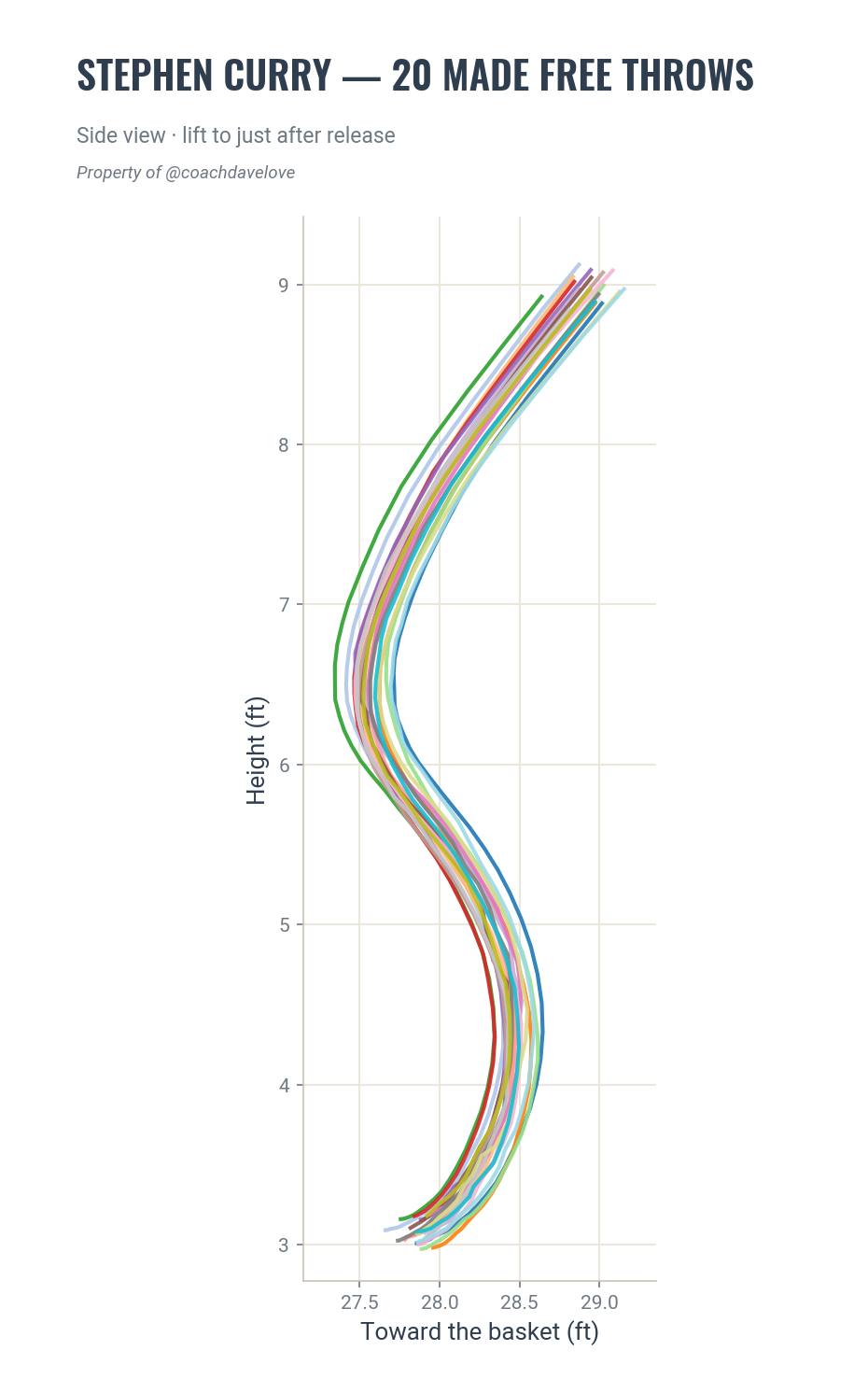
“Mastery isn't about making the same shot every time. It's about adapting to make the shot in any situation, because no two situations are exactly the same.”
Less variability builds a more brittle shooter
Here is the part that should change how you run practice. If you groove a shot only one way, under one set of conditions, you build a shot that works right up until the game changes one thing. It is brittle. It looks great in an empty gym and cracks under a closeout it never rehearsed.
“Every time a coach asks a player to try to repeat the exact same motion, they are unintentionally robbing the player of an opportunity to learn to adapt like they will need to in a game.”
Tweet thisVariety is what makes it robust, and the evidence for this is some of the sturdiest we have. Practice that mixes things up, different spots, rhythms, and demands, reliably produces worse numbers in the session and better retention and transfer to games than blocked, repetitive practice. That is the honest catch a coach has to make peace with: the practice that builds the game-ready shot often looks worse while you are running it. More misses today, more makes when it counts.
And this is one of the rare places the two big traditions agree. The cognitive camp's schema theory predicted decades ago that varied practice builds a more flexible internal rule. Ecological dynamics builds its entire method around exploring solutions. They disagree about why variety works. They do not disagree that it does. Approaches like differential learning, which deliberately injects variation and even "errors" so the system explores widely, take the idea to its edge.
The goal is the right amount, not the most
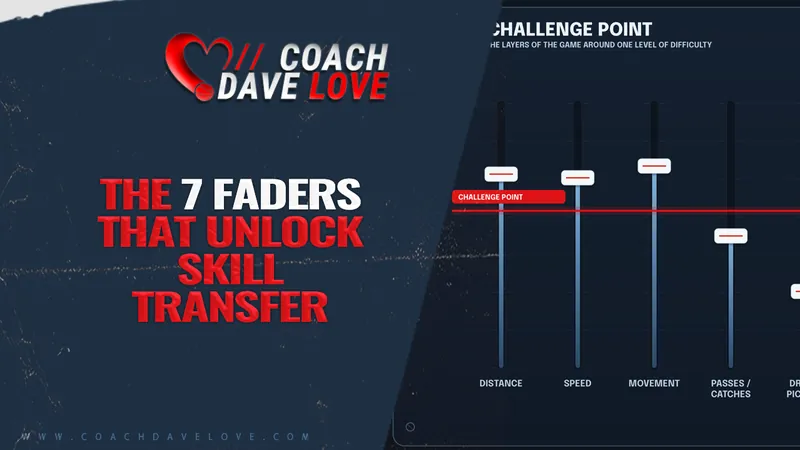
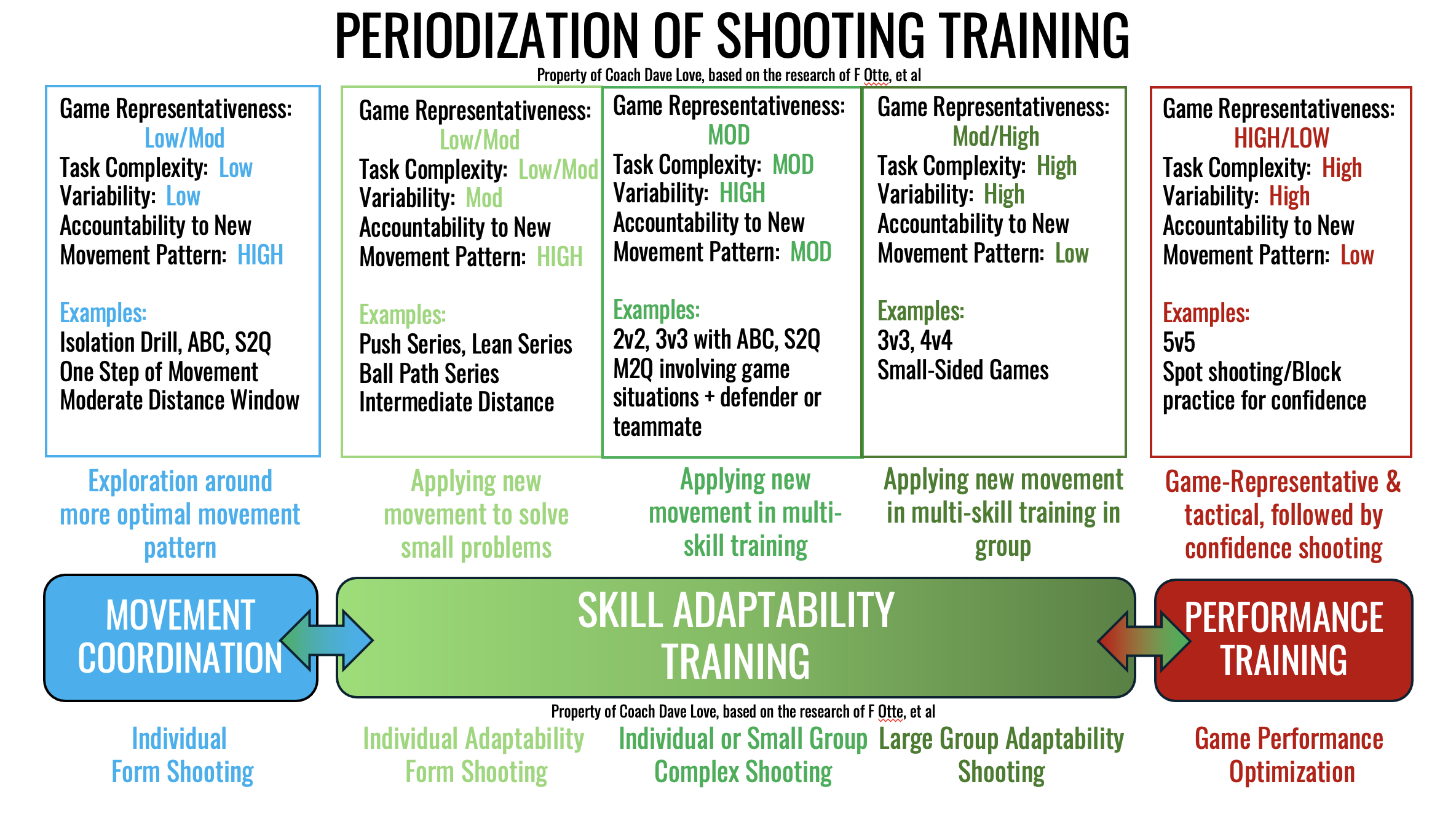
None of this means more variability is always better, or that you fire a beginner into chaos. The amount has to be matched to the learner. That is the Challenge Point: enough difficulty to force real problem-solving, not so much that the shot falls apart. I write about how I dial that in through the seven faders, and how I plan it across a season through periodization.
Let me head off a false choice, because this is exactly where people flip into binary thinking. Saying variability matters does not mean you never shoot the same shot, or that building habits is bad. We absolutely build habits. In skill-acquisition terms they are functional attractors: stable, efficient patterns a shooter's movement settles into and can return to under pressure. The goal is not to erase those attractors. It is to build good ones, and then explore and adapt around them, rather than mechanically repeating them. A habit you can flex is a skill. A habit you can only replay is the brittle shot we started with.
But notice the word is scaled, not removed. Even in a movement coordination phase of the PoST framework, when a player is exploring a brand-new, more functional movement and I want the environment simple, it is low variability, not no variability. There is almost always some challenge left in the mix, because a completely frozen, identical rep teaches a body almost nothing about the game it is preparing for.
Two things keep the variability honest rather than arbitrary. Representativeness means you vary what the game varies, real angles, closeouts, footwork, fatigue, not random noise for its own sake. And complexity means layering in the reads and decisions a shot actually lives inside. Turn those up at the right level and variability rises with them, which is exactly what you want.
CDL Coaching Toolbox
Release, arc, and balance measured shot to shot, so you can watch a shot get more adaptable over time. Free to try.
The bottom line
A shot is not a recording to be played back. It is a problem to be solved, slightly differently, every single time. The player who has only ever rehearsed one answer is fragile. The player who has explored the whole range can meet whatever the game hands them.
Variability is not the enemy of a reliable shot. It is how you build one. It builds adaptability, and adaptability is not a footnote to skill. It is the skill.
References
- Bernstein, N. A. (1967). The Co-ordination and Regulation of Movements. Pergamon Press.
- Schmidt, R. A. (1975). A schema theory of discrete motor skill learning. Psychological Review, 82(4), 225–260.
- Shea, J. B., & Morgan, R. L. (1979). Contextual interference effects on the acquisition, retention, and transfer of a motor skill. Journal of Experimental Psychology: Human Learning and Memory, 5(2), 179–187.
- Schöllhorn, W. I. (2000). Applications of systems dynamic principles to technique and strength training. Acta Academiae Olympiquae Estoniae, 8, 67–85.
- Seifert, L., Komar, J., Araújo, D., & Davids, K. (2016). Neurobiological degeneracy: A key property for functional adaptations of perception and action to constraints. Neuroscience & Biobehavioral Reviews, 69, 159–165.