Almost every time I'm a guest on a podcast, some version of the same question comes up: if you could only teach three habits, what would they be?
It's a great question, and an honest one. It's also a bit of a trap — because the truest answer is “it depends,” and nobody drives home from a podcast fired up about “it depends.” So let me give a real answer, and walk through the thinking underneath it.
Why it's a loaded question
Here's why the question is loaded. Every player arrives with their own set of constraints — their body, their history, their strength, their injuries, the way they naturally move. And every situation is different. That means I can't hand you a single set of rules — “bend your knees this much, hold your elbow there” — that works for all players in all situations. The moment I do, I'm coaching the rule instead of the player. That's the ecological reality of skill, and I've written about it at length.
“If I could hand you one rulebook that worked for every shooter, I'd be coaching the rulebook instead of the player.”
Tweet thisAnd yet — there are three things I'd protect on every shooter. Just not in the way the question implies. Be honest about it: only one of the three is a genuine task invariant — something the shot simply cannot do without. The other two aren't strictly required at all. There's significant wiggle room in both, and players succeed without them all the time — but they make the task far easier, and far more repeatable.
And here's what makes the podcast answer genuinely hard: even these can be fulfilled a huge variety of ways. Skill-acquisition researchers have a word for that — degeneracy — structurally different movements that produce the same functional outcome (Seifert et al., 2016; the idea traces back to Bernstein's motor equivalence in the 1960s). Two shooters can look nothing alike and satisfy the same principle perfectly. So think of what follows not as three habits to install, but as the three things I'd protect on any shooter — one requirement, two high-leverage principles.
Non-negotiable #1: Be as balanced as possible
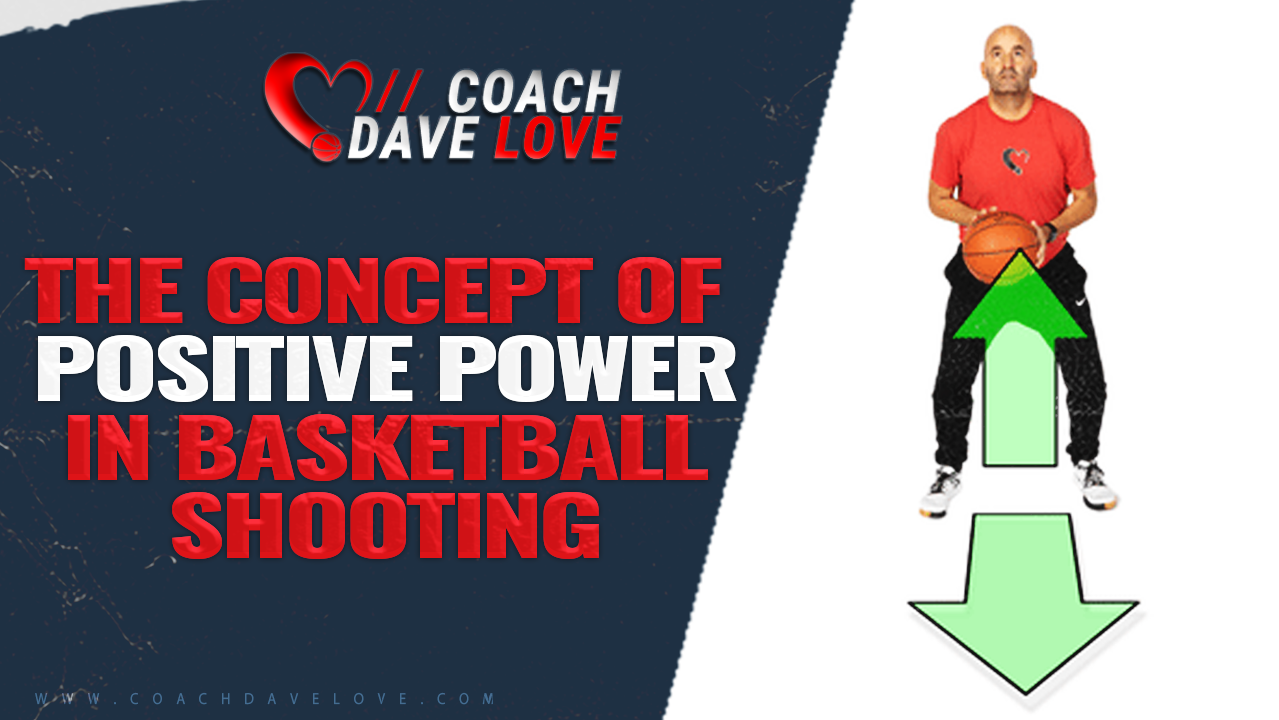
I define balance in a specific way. It's the ability to control the Negative Power that shows up before the shot — the movement, momentum, and forces moving away from the target line — so the player has a stable platform to create as much Positive Power as possible when they actually shoot.
CDL Coaching Toolbox
Balance, release symmetry, and arc aren't just feel — they're measurable. The Toolbox puts these ShotMetrics in your hands to use on your own players. Free to try.
Perfect balance isn't always available. A shooter coming off hard movement, fading, or contorting around a defender won't be perfectly balanced — and that's fine. The requirement isn't “be perfectly still.” It's “control and reduce what's working against you well enough to still deliver a clean shot.” Players can build habits that make that easier, but no single stance owns it.
Do I have an opinion on where most players should start? Of course. I think a base with the feet set a touch outside the hips is the middle of the sandbox for most shooters — a strong blend of stability and power, and, more importantly, the most adaptable place to be when a shot demands you trade one for the other. But that's a starting point I'd shape to the individual, not a law I'd enforce.
“Balance is the player's ability to reduce and control the amount of Negative Energy they create before the shot, so they have a slightly better chance of making each shot.”
Tweet thisNon-negotiable #2: Push both sides of the ball evenly, and toward the target
The second job is getting the ball travelling consistently along the target line. The simplest, most direct way to make that happen is to apply force evenly through the vertical middle of the ball, straight at the target.
Push harder on one side than the other, or push off to the side of the target, and one of two things happens: the ball leaves off-line, or the shooter has to bolt on a second move to cancel out the first. Now you have a compensation stacked on a compensation — a more complex motor pattern with more moving parts. And more parts means more that can drift under game constraints.
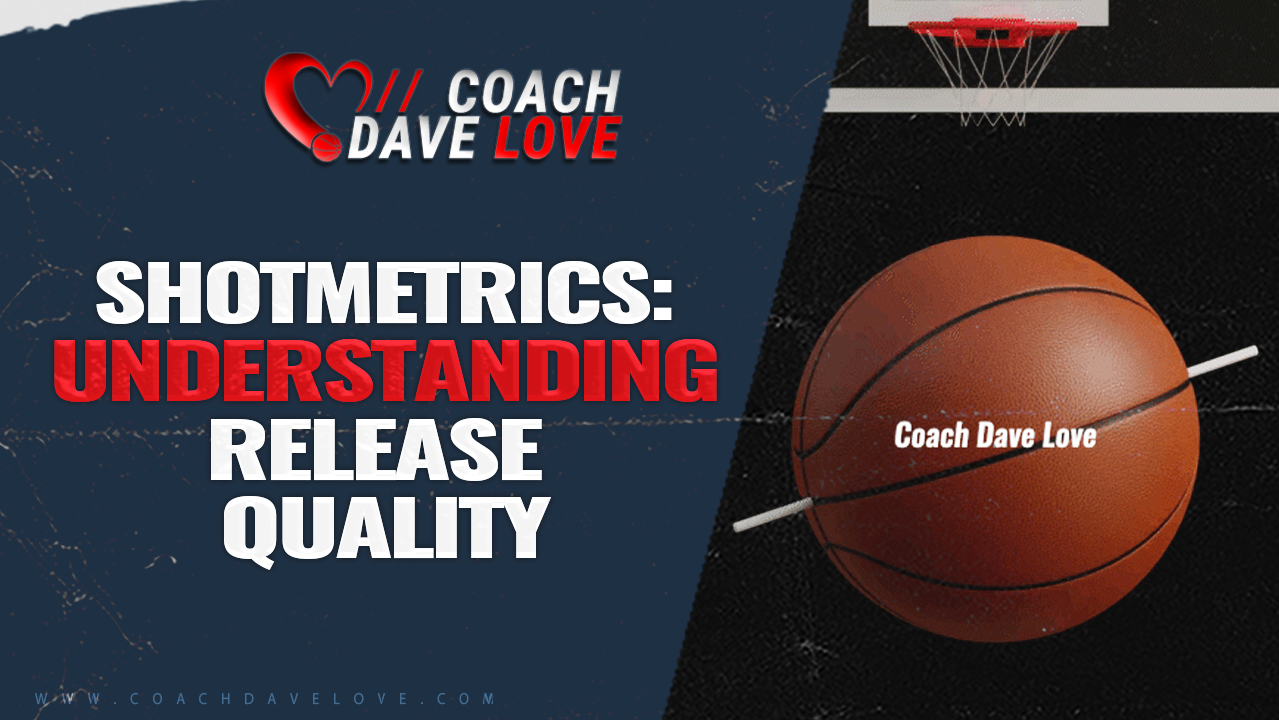
So the goal isn't a complex motion. It's a simpler one — the fewest compensations you can get away with. This is exactly what my research on Release Quality measures: when force is applied symmetrically, the ball spins cleanly about a level axis and holds its line; when it isn't, the spin tilts off-axis and the ball drifts. Same principle — now with a number on it.
If you could teach a shooter only three things, what would they be? NBA Shooting Coach Dave Love shares the three requirements he protects on every shot.
Share“Every compensation a shooter adds to their shooting mechanics is one more thing that can break under pressure. Aim for the simplest motion that gets the job done.”
Tweet thisNon-negotiable #3: Shoot with arc — drop it down onto the rim
This is the one of the three that's closest to a genuine, physical requirement. A shot has to come down into the basket, not drive flat at it — so it needs arc, full stop. A ball descending toward the rim sees a bigger opening than a ball arriving flat — it buys margin for error. Too flat, and the effective target shrinks toward nothing. On the flip side, too much arc and distance control becomes challenging. There is a very specific sweet-spot that fulfills both requirements.
And by now you can hear the pattern: there are many ways to get that arc. More lift from the legs, a higher release, a softer touch, a different launch angle — different solutions, same requirement met. I'm not going to tell every shooter to release at one “magic” angle. I'm going to make sure the ball drops onto the rim, and let the how fit the player.
So what does a coach actually do with this?
Here's where the three come together. When I sit down with a shooter who's struggling with one of these — they can't control their balance, they often miss left or right, they shoot a flat ball — I'm not reaching for a rule to install. I'm using my experience to constrain the activity: to change the task, the environment, or the setup so a more functional solution becomes the easy one to find. I guide the exploration; the player discovers their own version of the answer.
I may even have an idea of what I think is going to be the most functional solution. That doesn't mean I prescribe every part of the movement — it just means I constrain the task enough to ensure exploration, while staying open-minded to other solutions.
That's the constraints-led idea in practice, and it's why the same three requirements can produce a thousand different-looking shots. My job isn't to make everyone move the same. It's to make sure everyone's shot meets the physical requirements of the task — and then to help them adapt, because the game will absolutely force adaptation, and a shot that can only be performed one perfect way is a fragile one.
So the next time someone asks me for three habits on a podcast, that's the honest version of my answer: I don't teach three habits. I protect three requirements — balance, a straight and simple push through the ball, and arc that drops onto the rim — and I let each player fulfill them in the way that fits them best.
“I don't teach three habits. I protect three requirements — and let each player fulfill them in their own way. Have good balance, push both sides of the ball evenly and towards the target, and drop the ball down on the rim.”
Tweet thisReferences
- Seifert, L., Komar, J., Araújo, D., & Davids, K. (2016). Neurobiological degeneracy: A key property for functional adaptations of perception and action to constraints. Neuroscience & Biobehavioral Reviews, 69, 159–165.
- Bernstein, N. A. (1967). The co-ordination and regulation of movements. Pergamon Press.
- Newell, K. M. (1986). Constraints on the development of coordination. In M. G. Wade & H. T. A. Whiting (Eds.), Motor development in children: Aspects of coordination and control (pp. 341–360). Martinus Nijhoff.
- Davids, K., Button, C., & Bennett, S. J. (2008). Dynamics of skill acquisition: A constraints-led approach. Human Kinetics.