Ask most coaches to picture good shooting balance and they'll describe a player standing perfectly still — feet set, knees bent, chest up, weight even. But basketball almost never asks for that. Balance in a real shot isn't the absence of motion; it's the control of it — managing the energy flowing through the body so that movement carries toward the rim instead of away from it.
Why balance matters
Players are constantly moving, creating momentum in every direction — and all of that movement is energy. When it isn't controlled, it becomes what I call Negative Energy: movement that pulls the player or the ball away from the rim. A shooter drifting sideways who doesn't stop that energy carries it straight through the shooting motion, and it shows up as a miss in that direction, or as complicated mechanics fighting to recover.
So great shooters aren't motionless — they're good at getting control. It's rarely picture-perfect balance. They just learn to fight to keep the shot simple and organized no matter what came before it.
“Balance is the ability to manage how energy flows through the shot — not the absence of motion.”
Tweet thisBalance isn't one thing: the forms it takes
Balance isn't a single skill. The research bears this out — Paillard & Noé (2015) describe balance as multi-dimensional, with static, dynamic, reactive, and anticipatory (proactive) control, each shaped by the task and context. That matters for shooting, because balance failures happen at any point in a shot, not just the moment a player sets. When a shooter struggles, my first job is to figure out which kind is breaking down.
Static balance: the baseline, not the goal
Static balance is holding a position without losing control of your center of mass. It's foundational for a beginner or a player with limited strength or stability — but it's rarely the thing that decides makes and misses in a game. For a small group who really struggle with posture or foot stability, brief interventions help: pausing in the base before shooting, or holding a set position for two seconds to build awareness. But those reps should be short. Static drills are teaching moments, not training programs.
“Static drills are teaching moments, not training programs.”
Tweet thisDynamic balance: shooting on the move
Dynamic balance is control through continuous motion — coming off a pin-down, sprinting to the corner, stepping back into space. This is where most misses are born, usually when the footwork into the shot breaks down and the body starts "fighting itself." Here's where proactive (anticipatory) balance enters: at higher levels, great shooters don't just react to a bump — they prepare for it, reading defensive cues early to brace the core, pre-load the feet, or adjust the gather so they're stable before contact arrives.
Reactive balance: shooting through contact
Basketball rarely lets a shot go undisturbed — a shoulder on the gather, an awkward landing, a late contest forcing a mid-air adjustment. Reactive balance is regaining control after something unexpected. It's one of the most overlooked parts of shooting, especially for youth players who almost never train it. And the fix isn't wobble boards or BOSU balls — it's building the actual basketball problem into the rep: light bumps at different points in the pre-shot sequence, unpredictable closeouts, variable landings that flow straight into a shot.
Transitional balance: the real game-changer
If one type separates elite shooters, it's transitional balance — shifting seamlessly between balance states inside a single sequence. Picture a modern relocation three: sprinting off the ball (dynamic) → catching on one foot while absorbing contact (reactive) → stopping and reorganizing into a clean base (static) → elevating, often drifting slightly (dynamic again). That whole chain can take under a second. A player who can't transition efficiently between those phases wastes time, loses rhythm, and compromises the shot.
That's the pattern I see in the gym: a less athletic player might need static balance just to find control; a pro might lose dynamic balance when the movement gets too aggressive; but almost everyone struggles with transitional and reactive balance, because those are the moments that can't be pre-planned. Naming which one is failing is what makes the solution precise.
Why "just tell them the cues" doesn't transfer
There are a few habits that help in almost every situation — keep the feet outside the hips for a stable base, hold an athletic posture that allows quick adjustment, keep the core engaged to direct energy through the body. But those are tools, not a checklist, and simply drilling the postures won't make a player balanced. This is where the traditional information-processing approach falls apart — the belief that if we just tell a player "feet wide, chest up, drop your hips" and run block-practice reps where they're already balanced, it'll transfer to the game. Two realities get in the way.
- Every solution is context-dependent. How wide the feet need to be standing still isn't how wide they need to be sliding at speed. The posture that stabilizes forward movement isn't the one for moving backward or absorbing contact. Those habits are the trunk of the tree; the game lives in the branches.
- You can't script every variation. No list of cues covers the range of balance problems a game throws at a player.
So instead of overloading players with internal, step-by-step instructions, I shape behavior with constraints — space, timing, movement rules — and use guided questions to help them notice what matters: "Where did you feel your weight shift when the defender bumped you?" "How did changing your gather speed affect your ability to rise cleanly?" The cues become external — about outcomes and the environment, not isolated body parts. From an ecological-dynamics view, that's the whole point: strip away the defenders, movement, and variability and you strip away the very information the skill is built on. The practice has to represent the game, or it doesn't transfer.
Balance isn’t stillness — it’s controlling energy so movement flows toward the rim. Learn how Coach Dave Love trains its four forms, from static to transitional.
ShareHow I train it: MCT and SAT
Once I know which form of balance is the issue — and which habit or motor pattern is holding the player back — I design activities that challenge that specific kind of stability, and I let them evolve with the player's coordination level. This follows the Periodization of Shooting Training (PoST) model, moving between Movement Coordination Training (MCT) and Skill Adaptability Training (SAT) — and back — in a non-linear way.
MCT — Movement Coordination Training
The goal is to help a player feel and control large amounts of movement energy:
- Sprint-and-stop sequences.
- Jumping and landing with quick balance recovery.
- Explosive movements that force the player to absorb momentum and redirect it toward the rim.
I vary distances, directions, and ways to stop to push adaptability. The question I'm always asking: how do I build an activity that almost forces the player to figure out balance on their own?
SAT-MV — applying it under variability
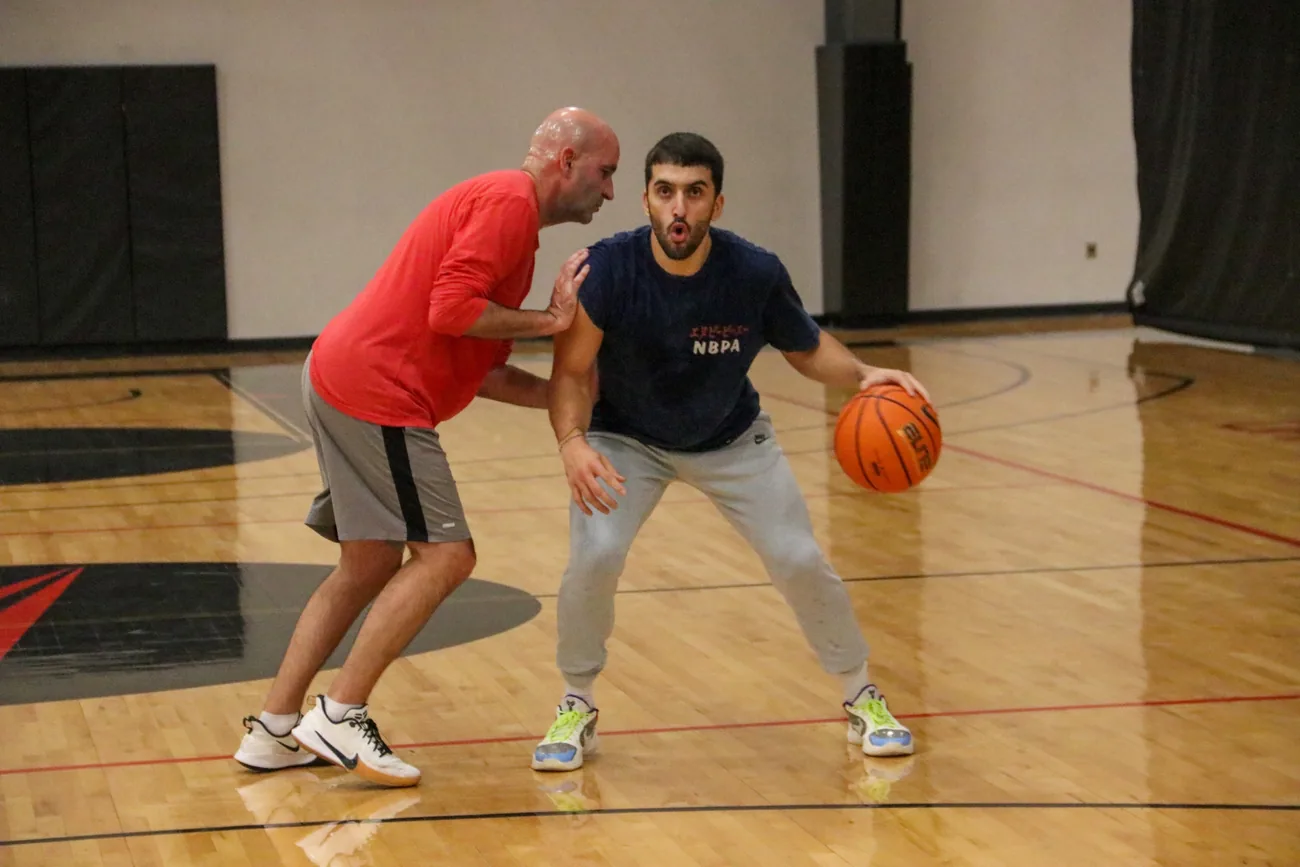
Now the player applies balance in more representative contexts, often 1v1 with a coach or teammate: the push drill or lean drill, added variability in passes, dribble pickups, or starting movements, and linking the balance challenge to a specific spot, movement, or read on the floor.
SAT-CT and SAT-TBT — context and time pressure
Finally, balance is tested in competitive, time-pressured situations with more defenders and teammates — small-sided games where the shooter must change direction before shooting, the defender must bump the shooter before the shot, or the coach calls a shot with limited time. Through all of it, the goal isn't perfection, it's awareness: players learning to feel when their balance supports or fights their energy, and adjust.
“The best shooters aren't balanced because they're still. They're balanced because they can find stability faster than the game can knock them off it.”
Tweet thisPeriodizing balance work
Like any skill, balance work is planned against the competitive schedule:
- MCT drills — early in the week or when there are several days before the next game. Higher-load, higher-chaos activities.
- SAT drills — as game day approaches, transferring that control into realistic, contextual shooting situations.
I weight the phases toward whatever type of balance is weakest. A player wrestling with a new movement pattern spends more time in MCT until it stabilizes; a player who mostly needs to hold reactive balance under game pressure spends more time in a SAT-TBT phase.
CDL Coaching Toolbox
The measurements behind everything I coach — balance, release symmetry, and arc — put in your hands to use on your own players. Free to try.
Takeaway
Balance isn't a posture — it's a process: the continuous act of controlling energy so movement flows toward the rim instead of away from it. Static balance matters, but only in small doses. Dynamic, reactive, and transitional balance decide who makes shots in real games, and proactive balance — anticipating the disruption before it lands — is what separates great shooters from good ones. When coaches understand the different forms of balance and build practice that actually challenges them, players develop shots that hold up under pressure — not because they were told what balance looks like, but because they learned how to find it.
“Balance isn't a posture — it's a process: controlling energy so movement flows toward the rim instead of away from it.”
Tweet thisReferences
- Paillard, T., & Noé, F. (2015). Techniques and methods for testing the postural function in healthy and pathological subjects. BioMed Research International, 2015, 891390.